Showing posts with label contemporary fiction. Show all posts

Thursday, June 2, 2022

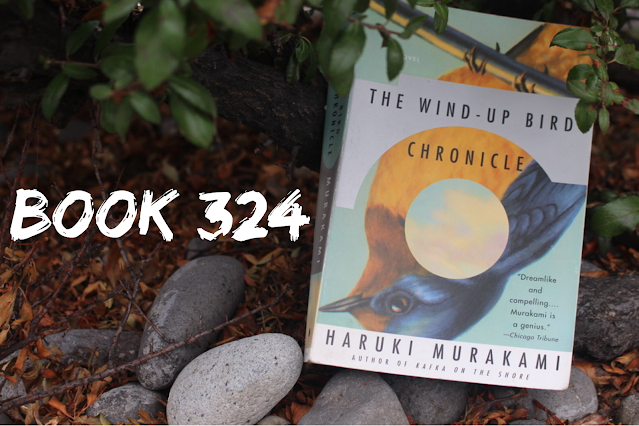
Book 324: The Wind-Up Bird Chronicle


"But even so, every now and then I would feel a violent stab of loneliness. The very water I drink, the very air I breathe, would feel like long, sharp needles. The pages of a book in my hands would take on the threatening metallic gleam of razor blades. I could hear the roots of loneliness creeping through me when the world was hushed at four o'clock in the morning." 

Dates read: June 27-July 5, 2019

Rating: 7/10

Lists/awards: 1001 Books You Must Read Before You Die

Sometimes I feel like living in the era of technology has robbed the world of its magic. Anyone with an internet connection can have access to what once were locals-only "secret" places. A rational explanation for something odd is almost always just a google away. You can have access to scads of information about almost anyone you meet in minutes. There's so little room left for actual mystery.

I remember reading somewhere that Haruki Murakami's books are among the most-stolen from bookstores. I'm not sure why that is, but there's no denying that the Japanese author has very devoted fans. Reading The Wind-Up Bird Chronicle was my first experience with him, and left me both sort of getting it and sort of not. It's a hard story to describe: there's a guy, Toru Okada, who lives outside of Tokyo with his wife, Kumiko, and their cat (which they've named Noboru Wataya, after her disliked brother) has gone missing. Toru has recently left his longtime job in a lawyer's office, but is unemployed while he tries to figure out what's next. Kumiko wants him to find the cat, and his searches for it lead him to strike up an acquaintance with a strange teenage girl, May, who lives down the block. That's when the phone calls start.

First, there's a woman who says she knows who he is and starts talking dirty to him. But then there's a psychic, a woman named Malta Kano, who explains that Kumiko has reached out to her to help with locating the cat. Kumiko and her family believe in things like psychics, having previously arranged for Kumiko and Toru to spend time with an old man called Mr. Honda, allegedly for spiritual consultations...but all that actually happens is that he repeatedly tells them about his experiences as a soldier in Manchuria during World War II. Toru meets with Malta Kano, and her sister, Cresta, but before long Kumiko herself disappears. She sends Toru a letter explaining that she's left him for a coworker with whom she's been having an affair, but he doesn't believe this and decides to try to find her, which brings him into contact with even more strange people, including a mother and son who he calls Nutmeg and Cinnamon. And appearing throughout is the sound of a bird, that sounds like something mechanical being wound.

This is a weird book, and I'm not sure I entirely understand it. It's one of those that you finish and almost want to flip right back to the beginning and start again, to see if it makes any more sense the second time through. I think there will be a second time through, though certainly not now. And there will definitely be more Murakami. If I had to chose a single word to describe it, it would be "dream-like". The way Murakami uses language and builds the world of the book create a feeling of constant loose connection, almost a structured free association, in which the concept that would tie everything together is just tantalizingly out of reach. It works well, and I found myself turning the pages and getting drawn further and further into it, though I suspected (correctly) that not everything was going to be tied up in a neat bow by the end.

Honestly, though, once I finished it, though I felt like I liked it, I have had a hard time articulating exactly why. It was obtuse, the female characters were largely underdeveloped (though I did love May), and it felt like some storylines were just dropped like hot potatoes. But despite its flaws, it's strangely compelling. There's something magical and mysterious about the world as Murakami creates it, and it did get me thinking about some of the deeper themes that were explored, like our obligations to each other as people and the nature of power in relationships. It's intellectually engaging despite the kind of haziness about it. If you're ready for something non-traditional, I would recommend this book.

One year ago, I was reading: Tooth and Claw

Two years ago, I was reading: Year of Wonders

Three years ago, I was reading: Delirium

Four years ago, I was reading: Boy, Snow, Bird

Five years ago, I was reading: Mrs. Dalloway

Six years ago, I was reading: Spinster

Thursday, February 17, 2022

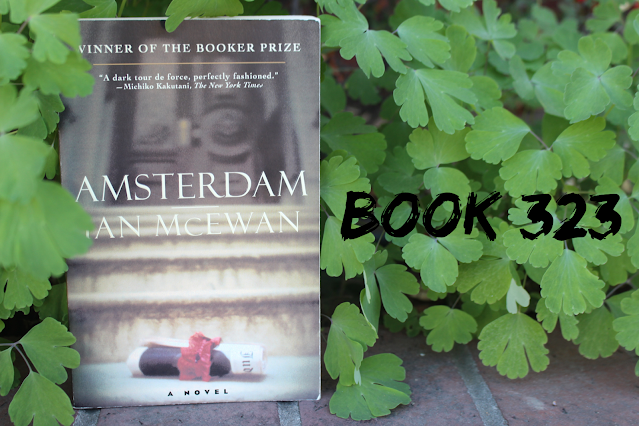
Book 323: Amsterdam


“As far as the welfare of every other living form on earth was concerned, the human project was not just a failure, it was a mistake from the very beginning.”

Dates read: June 25-27, 2019

Rating: 6/10

Lists: Booker Prize, The New York Times best-seller

Few things are more satisfying than boiling hot self-righteousness. If there's a drug that gives you that feeling of someone else being not just incorrect, but morally wrong, and being about to shove it in their face that you're a better person than they are, please no one tell me. I will become an addict. Of course, we all know that it is almost inevitably followed by realizing that you are not quite in fact as heroic as you felt, nor is the other person the literal spawn of Satan. But it's a heady rush while it lasts.

Even long-standing friendships aren't immune from misunderstanding and resentments. In Ian McEwan's Amsterdam, two old friends meet at the funeral of a woman they each had loved once. But it isn't the free-spirited Molly, now gone after a brief but terrible bout of dementia, that drives apart Vernon, the editor of a struggling London newspaper, and Clive, a respected composer. They've long since come to terms with that part of their lives. Neither of them can much understand what she ever saw in another one of her former lovers, who also attends the funeral: Julian, a conservative politician whose policy stances would seem to be anathema to Molly's guiding principles of love and acceptance. Nor can they understand why she married George, who seemed bent on controlling her and molding her into conventional respectability. Like many friends, Vernon and Clive have gone through cycles of being more or less close over the years, and the funeral pushes them back into each other's orbit. Spooked by the circumstances of Molly's death, each promises that if the other were to be in a similar state of decline, they would help the end come quicker.

Not long afterwards, both men find themselves in a position to have to make a moral choice. Vernon is given photographs that Molly took of Julian during their relationship...photos that his support base would find shocking. These photos would solidify Vernon's position at the paper by boosting circulation and catapult him into the spotlight after a lifetime of toiling away in relative obscurity. Clive has received a prestigious government commission to compose a piece to celebrate the millennium, and struggles for inspiration until, when taking a hike while out of town, he sees a man attack a woman on the trail. Finding himself suddenly able to see where he wants his symphony to go, he ignores the situation and doesn't report what he saw to the police. Clive is aghast that Vernon would even consider publishing the photos of someone else's private, intimate moments. Vernon is insistent that Clive report what he saw and face responsibility for his failure to intervene on behalf of the woman and keeping what he witnessed from law enforcement. The two are bitterly estranged.

This book is so short as to practically be a novella. That doesn't limit the impact of McEwan's satire, though. If you have ever known a pompous middle-aged man, Vernon and Clive are pitch-perfect. Both ruminate on the clarity of the situation facing the other, while running themselves ragged in the mental gymnastics required to justify their own choices. Each can only see the ways in which they themselves have been good, devoted friends, while the other has taken advantage of their generosity. But that's kind of one of the issues: character. While obviously something this brief and with this perspective isn't out for a deep character study, Vernon and Clive are basically the same person. And George, who shows up to create havoc throughout, seems more like a plot device than a human. I never found anyone compelling enough to really care about how it would end up.

How it ends up is a little too tidy and convenient, for that matter. And the pacing is odd...it drags and feels bloated (despite its brevity) in places, but the conclusion feels rushed. It's not without its clever moments and witty turns of phrase, but it really feels like an excellent short story concept that got padded into a decent-but-unspectacular short novel. It's worth a try (the upside of having such a low page count is that even if it doesn't work, it shouldn't take long to finish), but there are sharper, funnier satires out there. 

One year ago, I was reading: The Eyre Affair

Two years ago, I was reading: The Year of Reading Dangerously

Three years ago, I was reading: Daisy Jones & The Six

Four years ago, I was reading: My Name is Venus Black

Five years ago, I was reading: Nefertiti

Six years ago, I was reading: The Namesake

Thursday, February 10, 2022

Book 322: American Psycho


"There wasn’t a clear, identifiable emotion within me, except for greed and, possibly, total disgust. I had all the characteristics of a human being—flesh, blood, skin, hair—but my depersonalization was so intense, had gone so deep, that the normal ability to feel compassion had been eradicated, the victim of a slow, purposeful erasure. I was simply imitating reality, a rough resemblance of a human being, with only a dim corner of my mind functioning. Something horrible was happening and yet I couldn’t figure out why—I couldn’t put my finger on it." 

Dates read: June 21-25, 2019

Rating: 6/10

The trouble with having grown up prior to the YA boom is that when I was a teenager, once you ran out of the Lois Duncan, R.L Stine, and Sweet Valley High books, there wasn't a lot left. That's a bit of an oversimplification (the excellent Speak came out when I was in 9th grade, and obviously the Harry Potter series as well), but not too much. So I read a lot of adult literature. Some of which was just too complicated for me (I gave up about 60 pages into Anna Karenina), some of which went over my head, but a lot of which enriched my mind and expanded my boundaries! As a result of that experience, I've always been strongly opposed to any sort of censorship of teen reading...making sure you know what your kid is reading and talk to them about it, sure, but the reading is the important part.

I didn't think I would ever read anything that would make me think that an age restriction for a book could be realistically justified. And then I read Bret Easton Ellis's American Psycho. Patrick Bateman (older brother of The Rules of Attraction's Sean Bateman) is a New York City banking bro in the 1980s. It would seem like he has a pretty great life: his job is prestigious and pays well, he has a pretty fiancee, he works out regularly and is in good shape, he has a nice apartment. But what Patrick also has going on is a gnawing emptiness at his center, and violent urges he's not quite able to control. He lashes out at first against the powerless: poor people, prostitutes. But his need to hurt people escalates farther and farther until he's committing actual atrocities against even people he knows, while somehow still trying to keep it together enough to go to work and live his life as normally as possible.

I'm not usually overly puritanical about depictions of sex and violence in books. Sex and violence are (fortunately and unfortunately, respectively) parts of life. And I'd seen the movie! I thought I had a handle on what was in store. But this book doesn't just flounce right over the line of being gratuitous, it goes into actively stomach-churning territory. There are things I read in this book that gave me pictures in my head I will never unsee and honestly gave me heaves. And part of it, I think, is deliberate...besides being just gross, the book is also a razor-sharp satire. A recurring motif are Bateman's much-stressed-about trips to the video store, where he rents violent pornography which desensitizes him both towards normal sex and violence against women. Living in a culture where depictions of outlandish acts of sex and violence are easy to access means that it requires yet more extreme examples to achieve the titillating/disturbing effect...examples, of course, that the text itself provides. It's clever, if also very off-putting.

I had a really hard time deciding how I felt about this book. As a cutting send-up of the consumer culture of the 1980s, particularly in the heart of the NYC finance scene, it was extremely effective and often entertaining. The agonies about getting a table at the latest bougie restaurant serving the most unappetizing-seeming "exotic" food combinations were dead on. The way the book played with identity, with Patrick both constantly mistaking people he sees for people he knows and being wrong, and himself being called by the incorrect name, because as seriously as he takes his outfits (most of which are described in detail), the end result is that he looks just like everyone else, was smart and insightful. I would be pulled in and admiring the craft of it...and then there would be a gruesome murder and I would pulled back out again.

Even just skimming much of the over-the-top portions of the book (it gets worse and worse as it goes along), it was a reading experience I found really difficult. This book has age restrictions for access in several countries, and I'm actually not mad about it. I might have found one of the few things I actually don't think a teenager should read without an adult having to be a part of the process. I don't know that I would affirmatively recommend that anyone read this book, it's that messed up. Which is a pity, because the parts of it that are satirical are incredibly well-executed (pun sort-of intended) and effective. But the rest of it is just too much. Yes, it's worse than the movie. Much, much worse. If your interest in still piqued and you have an iron stomach, there is merit here. But be prepared. 

One year ago, I was reading: The Leftovers

Two years ago, I was reading: The Lives of Tudor Women

Three years ago, I was reading: Forest Dark

Four years ago, I was reading: Wonder Boys

Five years ago, I was reading: Between the World and Me

Six years ago, I was reading: Ahab's Wife

Thursday, January 27, 2022

Book 320: There There


"He moves in front of the mirror and his feathers shake. He catches the hesitation, the worry in his eyes, there in the mirror. He worries suddenly that Opal might come into the room, where Orvil is doing..what? There would be too much to explain. He wonders what she would do if she caught him. Ever since they were in her care, Opal had been openly against any of them doing anything Indian. She treated it all like it was something they could decide for themselves when they were old enough. Like drinking or driving or smoking or voting. Indianing." 

Dates read: June 7-10, 2019

Rating: 8/10

Lists/awards: American Book Award

DNA tests can do cool things these days. Not only does mine show me that I'm part Polish, it can even identify the area in Poland where my family came from! Does it actually matter, at the end of the day? Well, no. If I ever do visit Poland, it would almost certainly be to go to one of the major cities, not the tiny village in Podkarpackie Voivodeship that my great-grandfather left over a century ago. But it's interesting to be able to confirm that tie to the past, to get a better sense of where I come from and what my family's story is.

For Native Americans living on reservations in a community that includes elders, a sense of connection with the past is probably more tangible. But of course, that's not where all Native Americans live. Plenty of them live in cities, and it's an attempt to put together a pow-wow in Oakland that brings together the characters of Tommy Orange's debut novel, There There. Through changing point-of-view chapters from a wide cast, the book tells the story of how the pow-wow brings people together in unexpected ways...and what happens when a group of young men eye the prize money for the dance competition as a target for robbery. Common throughout are the questions the characters have about identity, and what it means to be an Indian in a large city.

The character wrestling most with identity and meaning is Dene Oxendene, who wins a competition for grant money that he intends to use to record Indian people telling their own stories about their lives. He sees the pow-wow as an opportunity to film many people at once. But there's also Edwin, whose interest in participating in the event, and breaking out of his self-imposed social isolation, is sparked by the discovery of his Indian father via social media. The internet is also how teenage Orvil tries to connect with his culture, as his stern grandmother Opal Viola Victoria Bear Shield (who was taken to the AIM takeover of Alcatraz as a child, along with her sister Jacquie Red Feather, by their unstable mother) who is raising him and his brothers refuses to talk about being Indian with them. Orvil learns tribal dances from YouTube, and plans to enter the dance competition. But the internet also provides a group of young men (including Tony Loneman, angry at the scorn he's received because of his fetal alcohol syndrome) with the schematics to 3D print guns from plastic that could be snuck past the metal detectors at the pow-wow, so they can get money to remedy a drug deal gone wrong.

Tommy Orange is a dazzling talent and this is a very good book. I would say that the only thing holding it back from greatness, for me, is that I wished it was told with a more traditional story structure. While each character's perspective was distinct and important, I found it hard to keep track of who everyone was in relation to everyone else, and a more well-delineated central narrative thread would have, for me, made the book's impact even more powerful. But the reality is that it's powerful anyways. I really cannot overstate how good Orange's writing is. These characters feel like they actually exist in the world, like each one of them, no matter how small a part they play, have full lives and histories that we're only able to get hints of. He switches back and forth between first- and third-person perspective, and even writes one chapter in the second person, which didn't add anything narratively as far as I was concerned as much as feeling like the exuberance of an artist pushing at the boundaries of what he can do.

In a way, this felt like an answer to one of the most well-known writers of Native American adult literature today: Louise Erdrich. While Erdrich's work focuses primarily on women, particularly older women, on reservations in the northern Great Plains, Orange's novel highlights men, especially young men, in a large Californian city. What they share is a story structure in which there are multiple characters that are the focus of one chapter at a time in a non-chronological narrative, as well as a focus on how to live in the world as an Indian today. Erdrich, who has won the National Book Award and been a finalist for the Pulitzer Prize, is a big name to invite comparisons with, but Orange lives up to it. This book is a must-read, and I can't wait to see what Tommy Orange does next.  

One year ago, I was reading: All Girls

Two years ago, I was reading: Followers

Three years ago, I was reading: Bad Blood

Four years ago, I was reading: Mansfield Park

Five years ago, I was reading: Bury My Heart at Wounded Knee

Six years ago, I was reading: Creative Mythology

Thursday, January 20, 2022

Book 319: Good Riddance


"I was never someone to let things go, and I wasn't going to start now. Besides being furious and impatient, I was worried that word would have gotten around Pickering. What if some bigmouth wrote to my father with misguided congratulations about how his late wife's yearbook had made the big time?" 

Dates read: June 3-7, 2019

Rating: 2/10

I think Facebook has destroyed the high school reunion. Where once upon a time people might have shown up to find out who got married, who got divorced, who succeeded and who didn't, now all of that information is available online on demand. If I want to know if the girl who was awful to me my freshman year had her life turn out okay, I can click over to her profile and see what she looks like and her husband and kids and where she works. It takes the mystery out of it. And once you get that primal gossipy urge satisfied, is there really a reason to go? Aren't you probably still in touch with the people from that time in your life that you want to be in touch with?

I do still have all my yearbooks, and when I go home I like to fish them out from my mom's attic or garage or wherever she has them now and look back at them, at the teams and the teachers and the classmates who managed to avoid social media, and read the notes from the people who I sat next to in fifth period Spanish and then never spoke to again. In Elinor Lipman's Good Riddance, Daphne Maritch inherits her mother June's cherished yearbook after she dies and isn't really sure what to do with it. It isn't from her mother's own high school years...rather, she served as the faculty advisor for the yearbook staff for the class of 1968, when she was herself a very young teacher, and kept detailed annotations on the lives of the students of that class. In a fit of decluttering, Daphne decides to toss the book. Only to have it turn up back on her doorstep, in the arms of a neighbor, Geneva, who thinks she wants to make a documentary out of it.

Though initially upset by the purloining and potential commercial exploitation of her mother's once-prized belonging, Daphne agrees to accompany Geneva to the next reunion so she can begin research into the students in the class. While there, she learns a secret about her mother that calls into question everything she thought she knew about who her mother was. With the help of her cute, younger across-the-hall neighbor Jeremy, things escalate into increasingly wacky hijinks as she tries to stop Geneva's plans from moving forward...and tries to help her now-widowed father cope with his move to join her in New York City and maybe find love again himself.

There's a good story to tell based on this general concept, I think, but it's not this one. I've always maintained that truly funny books are some of the most difficult to write, because it's so easy for the humor to land wrong, for the balance of real feeling necessary for people to care about characters and the funny stuff to wind up off. Lipman's book is not all successful in finding a balance, mostly because it seems to forget that it needs to be grounded in reality at all. She gives Daphne a sympathetic story (swept away by a charming man...who, it turns out, needed to be married to fulfill a condition of inheritance and had no interest in anything like fidelity, and so is now divorced), but barely gives us any time to get to know her or care about her before getting into the machinations of the plot, so I never connected with her. Which meant that I didn't really care about her relationship with her father, or her budding relationship with Jeremy, or if she'd ever put a stop to Geneva's yearbook schemes.

I can tell the plot is supposed to be madcap and absurd in a funny way, but it turns out the idea of having life-changing revelations delivered to characters in bathroom stalls with virtually no build-up just doesn't really work. The stakes are too high to be this breezy about it. It at least moves along briskly, but that's more because it doesn't seem to care to develop any of its plot threads in favor of just making new things happen instead. And the prose, while not actively bad, is deeply mediocre. There's hardly any wit or verve. I don't know who the target reader is for this kind of book, but I know it's not me. I hated it and wouldn't recommend it to anyone.

One year ago, I was reading: American War

Two years ago, I was reading: Mozart in the Jungle

Three years ago, I was reading: A Tale for the Time Being

Four years ago, I was reading: An American Marriage

Five years ago, I was reading: Snow

Six years ago, I was reading: Creative Mythology

Thursday, January 6, 2022

Book 317: Midnight's Children


"Does one error invalidate the entire fabric? Am I so far gone, in my desperate need for meaning, that I'm prepared to distort everything—to re-write the whole history of my times purely in order to place myself in a central role? Today, in my confusion, I can't judge. I'll have to leave it to others. For me, there can be no going back; I must finish what I've started, even if, inevitably, what I finish turns out not to be what I began..."

Dates read: May 20-29, 2019

Rating: 8/10

Lists/awards: Booker Prize, Time's All-Time 100 Novels

I have many issues with how history is taught in public schools, but one of the biggest is how little time gets spent on the Eastern hemisphere. Lots of America, obviously, but outside of learning about the Fertile Crescent and Ancient Egypt again and again and again, we don't get into much besides Europe. I have to imagine that most countries focus heavily on themselves and their immediate neighbors when they study the past, but some of the oldest, richest civilizations in the world are on the other side of the globe and we barely study them! I wish it were otherwise, but sadly I am not in charge of things.

The more books I read set in India, the more I wish I had a firm grasp of modern Indian history. Indian independence, and the partition that followed, continue to resonate not just in literature, but on a global political scale. Salman Rushdie explores these momentous events through his Booker Prize-winning epic, Midnight's Children. The novel tells the story of Saleem Sinai, born at the moment India begins post-colonial self-rule, and tracks his life as it, and his country, develop. But its more ambitious even than that: it begins with his grandparents and their youth, then tells the story of his own parents, and only then turns its full attention to its own protagonist.

Saleem is born to Ahmed and Amina Sinai, well-off Muslims living in Bombay, at exactly midnight on the day the British officially surrender the country, at the same moment as another child, a Hindu boy called Shiva. It turns out there are 1,001 children born in that first hour of India's modern life, and each of them have a gift, a magical power...and the closer to midnight, the stronger that power is. Saleem doesn't discover his until he is nine, when he begins to hear voices in his head: those of the other "children of midnight", who can speak to not only him but each other as he psychically hosts them. He eventually loses this power, but develops the ability to smell the feelings of other people. As he continues to grow, his fate (along with those of his parents and his little sister Jamila, called "The Brass Monkey" as a child for her hair color) is tied to that of his homeland.

There's much, much more than that, of course. Even attempting a brief outline of the twists and turns of Rushdie's tremendously complicated plot (and enormous cast of characters) would take several paragraphs. It's truly a stunningly ambitious novel, and what's even more stunning is that it mostly pulls it off. Characters come and go organically, storylines are fully developed and have solid payoffs. Rushdie writes the story to be narrated by Saleem himself to a female companion from roughly the modern day (when the book was written), and superbly uses that technique to frame it and give it momentum. It's deep, and rich, and beautifully written and constructed.

While it is undisputedly a masterwork, though, I don't know that I actually loved it as much as I respect it. Part of that is that I simply don't have enough context for it. Even as an educated person, my understanding of modern Indian history is thin and this book is the kind that requires a higher level of knowledge to really comprehend everything that it's doing. And while Rushdie mostly maintains the plot's progression nimbly despite the text's density, by the end there have been just so many characters and the scope is so vast that I found myself a little burned out and ready for it to end. It is not a book that should be read in snippets here and there, it demands and requires full and sustained bouts of attention. If you're ready to read a modern classic that's going to need a lot from you as a reader and reward the work you put into it, I'd highly recommend it. If you're looking for something on the easier side, though, leave this one until you're really ready to sink your teeth into something. 

One year ago, I was reading: The Satanic Verses

Two years ago, I was reading: Native Speaker

Three years ago, I was reading: The Winter of the Witch

Four years ago, I was reading: Ghost Wars

Five years ago, I was reading: American Heiress

Six years ago, I was reading: The Serpent King

Thursday, December 16, 2021

Book 314: Battleborn


"P.S. On second thought, perhaps sometimes these things are best left by the side of the road, as it were. Sometimes a person wants a part of you that's no good. Sometimes love is a wound that opens and closes, opens and closes, all our lives."

Dates read: May 7-11, 2019

Rating: 8/10

I've lived in Nevada for nearly a decade now. I first came to the state during the brief period in the late 90s when Las Vegas tried to market itself as family-friendly, and my mom brought my sister and me there as part of a trip where we also went to the Grand Canyon. I didn't return until college, when I came out to visit the guy I dated off-and-on for years during a summer break at his home in Reno. We had another one of our spectacular bust-ups (which didn't stick), but I tearfully vowed at the airport to never return. Then in 2012, I got a job as an organizer in Nevada, and opted for the more hospitable northern end of the state over the southern end in July. Then I met my husband, and here I still am.

Though I will always be a Michigander at heart, after almost ten years, I'm very loyal to my adopted state. How can you tell a Nevadan? If you call the state "Nev-AH-da" around them, they will either smile politely and scream internally, or find themselves unable to help blurting out that it's "Nev-AD-a". Though the state's official motto is "All For Our Country", it's the unofficial one, "Battle Born", that lent itself to becoming the title of native Nevadan Claire Vaye Watkins's collection of short stories, being elided into one word as Battleborn. Each story is connected to the Silver State, its rich history, and its mythos.

Watkins is extremely talented, and shows that off by writing a variety of styles and scenarios: there's a story ("The Diggings") about a family caught up in the mining booms on either side of the Sierra Nevada that's long enough to be a novella, there's one ("Rodine al Nido") about a girl, with whom we're drawn into troubling complicity by the way Watkins names her only as "our girl", who leads a friend into a bad situation with men in a Vegas hotel room, there's one ("The Past Perfect, the Past Continues, the Simple Past") about a young Italian man who winds up at a brothel after his friend disappears in the desert, and seven more. What connects these stories is not only their Nevada setting, but a sense of loneliness and alienation that's sharpened by that environment: the endless sky and open landscape can leave you with a feeling of being untethered to the world around you. Outside of the two major population centers (Reno and Las Vegas), Nevada is a largely rural state, with some areas so far off the grid they're actually referred to as "frontier". It's also quite large...there's about 8 hours of desert between those two urban areas. To be alone in such a place presents both a certain kind of security and a terrifying vulnerability, the tension between which Watkins deftly explores.

As always with a short story collection, there were highlights and lowlights, though this book was among the more consistently high-quality ones of its kind I can remember reading. The ones I've highlighted above were probably my favorites, with "Rodine al Nido" the one that lingered in my head long after I'd turned the pages. I don't think any of them were actively bad, but some of them (like "The Archivist" and the epistolary "The Last Thing We Need") weren't especially memorable and only came back to me as I flipped back through the book to refresh my memory before writing about it. It's impossible to doubt either Watkins's gift or her craft after reading this collection, and I'd recommend it very highly, particularly for short story-lovers or Western enthusiasts. 

One year ago, I was reading: Men Explain Things To Me

Two years ago, I was reading: House of Cards

Three years ago, I was reading: The Goldfinch

Four years ago, I was reading: The Lady of the Rivers

Five years ago, I was reading: The Red Queen

Six years ago, I was reading: Occidental Mythology

Thursday, November 25, 2021

Book 311: The Lowland


"The future haunted but kept her alive; it remained her sustenance and also her predator. Each year began with an unmarked diary. A version of a clock, printed and bound. She never recorded her impressions in them. Instead she used them to write rough drafts of compositions, or work out sums. Even when she was a child, each page of a diary she had yet to turn, containing events yet to be experienced, filled her with anxiety instead of promise. Like walking up a staircase in darkness. What proof was there that another December would come?"

Dates read: April 20-26, 2019

Rating: 8/10

I tend to believe Tolstoy when it comes to that stuff about unhappy families. Except that I think that there are so few truly happy families that we can safely exclude them from the data set. Pretty much every family has its own special kind of unhappiness. All of our parents screwed us up in their own ways. And their parents screwed them up, and we'll screw our own children up. The only thing to be done is to do your best to keep the damage minimal.

In Jhumpa Lahari's The Lowland, brothers Subhash and Udayan are so close that they're often confused for twins despite being a few years apart. They have a more or less happy childhood, building radios and playing in the marshy lowlands near their family's Calcutta home. As they start to grow up, they start to grow apart. Udayan becomes political, part of the Naxalite movement being repressed by the authorities. Subhash, on the other hand, turns towards school, eventually leaving India to study marine biology in Rhode Island. Separated by thousands of miles, the brothers do still write letters to each other, and Subhash is surprised to find out in one of them that his brother has gotten married. In defiance of expectations for his parents to chose a bride, Udayan has married a college student, Gauri, for love. Not too long afterwards, though, Udayan is killed.

When Subhash returns home for his brother's funeral, he finds an untenable situation: Gauri is pregnant, and his parents are planning to take the child to raise and kick her out after the birth. There's only one way out that he can see: he'll marry her, bring her back to the United States, and they'll raise the child as a family. With nowhere else to go, Gauri agrees. But this doesn't mean that everything's suddenly okay. Gauri gives birth to a daughter, Bela, and Subhash devotes himself to being a father. Gauri, though, is still traumatized by the death of her husband and the second marriage she had no real choice but to go through with. As Bela grows up, the family's tensions stretch to the breaking point.
 
This book is epic in scope, tracking Subhash through nearly his entire life and other characters, like Gauri and Bela, through much of theirs. Lahiri does her usual beautiful character work here...Udayan doesn't get a lot of narrative time until a flashback near the end, which leaves him feeling slightly unrealized, but the rest are developed in a way that feels achingly real. Gauri makes a decision that leaves her probably the least sympathetic of them, but the way Lahiri builds up to it, and what happens after, make it understandable. I also appreciated Bela's arc, the way that it seemed like she would grow up to become one sort of person because of the environment she was raised in, and then other events leading her to become a very different sort of person instead. All three of the major players were fascinating and I wanted to spend more time with them.

This is definitely one for people who prefer character over plot. Little actually "happens" besides a family coming together and coming apart. There's a more dramatic bit at the end, the part that goes back to the events leading up to Udayan's death, but I almost wished it hadn't been there or it had been told in its proper place in the chronology. I tend to think that Lahiri's writing is elegant almost to the point of being restrained, and having this part at the end feels out-of-character. That emotional remove, though, is what kept me from enjoying this novel more. It's a sophisticated work, but it deals with big emotions, and it felt like Lahiri was more devoted to keeping that style over letting the book really breathe, letting those feelings really build and explode. As it was, I admired it but didn't really connect with it. Still, it's a very well-written novel and one that I would definitely recommend to others.

One year ago, I was reading: Let's Explore Diabetes With Owls

Two years ago, I was reading: After The Party

Three years ago, I was reading: The Possibilities

Four years ago, I was reading: In The Woods

Five years ago, I was reading: The Girls

Six years ago, I was reading: Oriental Mythology

Thursday, November 18, 2021

Book 310: The Fever


"As Deenie walked out, a coolness began to sink into her. The feeling that something was wrong with Lise, but the wrongness was large and without reference. She’d seen Lise with a hangover, with mono. She’d seen girlfriends throw up behind the loading dock after football games and faint in gym class, their bodies loaded with diet pills and cigarettes. She’d seen Gabby black out in the girls’ room after she gave blood. But those times never felt like this. Lying on the floor, her mouth open, tongue lolling, Lise hadn’t seemed like a girl at all."

Dates read: April 15-20, 2019

Rating: 6/10

Teenage girls can be sociopaths. With many of the same destructive urges as boys, but less access to sanctioned casual physical aggression, we end up with a capacity for true interpersonal viciousness. I know I did some totally ice cold mean girl stuff when I was in high school, and wound up on the receiving end of something similar as a college freshman. I cut off my best friend for years over a dust-up I can't even remember. I was awful to my own little sister. Those emotions, the bad ones just as much or more than the good, are so close the surface at that time of life. I look back on it now and feel a lot of regret, but I remember how right it all seemed at the time.

I might have had smoother skin and been much thinner, but I wouldn't go back to being a teenage girl and feeling all those feelings again for anything. It's such a confusing and heady place to be, and Megan Abbott's The Fever really digs into the murky territory that friendships at that age can turn into. Deenie Nash and Lise Daniels have been best friends since they were small, but things are starting to change. They've recently started hanging out with Gabby, who a parent would probably euphemistically describe as coming from "a troubled home". And Lise has grown from a cute little kid into a pretty teenager. This has not escaped notice by Deenie, or her older brother Eli (himself the subject of significant attention for his looks), or even her father Tom, a teacher at the high school. This is all putting strain on Deenie and Lise's friendship, and then one day during class, out of nowhere, Lise falls out of her chair and has a seizure.

This alone is troubling, but then Gabby has a seizure too. One girl having a mysterious medical episode in a small town is cause for concern. Two is cause for alarm, especially as the doctors can provide no answers. Deenie thinks it might have been caused by a lake, rumored to be unclean, that all the girls spent time in together shortly before the episodes began. She worries that she might be next. Parents want to protect their daughters, start looking for a culprit. Hysteria starts to build as yet another girl is stricken, much of it focusing on the HPV vaccinations that the school mandated for the girls. The entire Nash family find themselves drawn further and further into the mystery and when it's finally unraveled, it's a doozy.

I won't spoil anything, but the real villain of this book is teenage sexuality. Specifically, teenage girls having sex. That's what the real terror of the parents over the HPV vaccine is driven by, the idea that their daughters might be sexually active. But it's not just the parental fear. The book is steeped in sex in a very realistically teenage way: girls worrying about who's having it, who isn't, if the boy you like is sleeping with someone, if you think he might want to sleep with you, wanting to do it, not wanting to do it. For all I know, boys probably have the same kinds of thoughts, but having been a girl, I know that for all of the innocence that's attributed to female-shaped persons, they are often consumed with questions of sex. Like Deenie with Lise and Gabby, you measure yourself against your friends: who's the desirable one? Who's the innocent? Who's the slut?

Thematically, this is a potent work. Abbott beautifully captures the atmosphere of small town paranoia and the thrill and terror of being what Britney Spears would call not a girl, not yet a woman. But reading this book had its frustrations as well: the tension ratcheted up too high, too soon, leaving it nowhere to really go once things got really dramatic. The plot felt slightly underbaked and the pacing was kind of stop and start. And I thought having the dad, Tom, as a main character didn't really work. I appreciated the inclusion of Eli, the perspective on teenage boys and sex made the book as a whole feel more balanced, but Tom didn't add much for me. All together, I think this was an interesting, well-written novel and I'd recommend it if teenage psychological thriller is a genre you enjoy!

One year ago, I was reading: Plain Bad Heroines

Two years ago, I was reading: The Talented Mr. Ripley

Three years ago, I was reading: Uncle Tungsten

Four years ago, I was reading: The House of Mirth

Five years ago, I was reading: Eleanor of Aquitaine

Six years ago, I was reading: Oriental Mythology

Thursday, November 4, 2021

Book 308: The Last Romantics


"Some people will choose, again and again, to destroy what it is they value most."

Dates read: April 7-11, 2019

Rating: 8/10

Like most of the oldest children I know, I tend to feel responsible for other people. I'm always wanting to know where my husband or coworkers or friends are heading off to, and I think that's a bit rooted in growing up knowing that I needed to know where my sister was. I also tend towards bossiness and overachieving in a way that's typical of oldest kids. I'm not sure that I 100% buy into birth order theories as a whole, every family is different, but I do think there are some broad generalizations that can be made and that will turn out to be accurate more often than not.

I had just one little sister to be responsible for. There are four Skinner siblings in Tara Conklin's The Last Romantics. Renee is the oldest, the responsible one. Caroline, the next oldest, is soft-hearted and traditional. Then Joe, the only boy, the gifted athlete, the apple of everyone's eye. And finally Fiona, the baby. The Skinners are a happy family until they're not: when their father dies in an accident, their mother Noni finds out that they're not as well off as she thought, and the loss of not only her husband but the life she thought she had achieved pitches her into a deep depression. They downsize, and Noni takes to her bed. Not for a week or two, or even a month on two, but for a couple years. The Skinner children are more or less left to raise themselves during what they come to call The Pause.

The seeds of what will become of them are planted during The Pause. Renee takes her responsibilities to take care of the others seriously, and becomes dedicated to achieving at a level that will keep anyone from guessing what's going on at home, setting her down a path towards becoming a doctor. Caroline falls in with a neighbor family, forming a bond with one of their boys that will deepen into romance and marriage. Joe's talent and good looks ensure that his outward needs are met, even if he struggles to process his trauma. And Fiona learns to observe, a skill that comes in handy as she becomes a writer and poet. Noni does recover, and the family seems more or less intact, but the damage that's been done can't be undone.

I was biased towards this one from the start: this kind of following-a-group-of-characters-over-time thing is something I absolutely love in a book. I tend to find that the books that stay with me the most are ones where character is first and foremost, and this book is all about character. The siblings and their relationships feel complicated and real. Though they all had moments of being their worst selves, their behaviors felt rooted in how their experiences, particularly during their childhoods, interacted with their innate personalities. I also appreciated that the book never felt the need to have there be a dramatic confrontation between the children and their mother...it generally leaned away from melodrama rather than leaning into it, and I think there are plenty of families that do just try their best to forget the bad moments and move on.

As much as I loved this book for the most part, there were some plot elements that kept me from considering it truly great. First was that The Pause could go on for multiple years without anyone really noticing. As much as Renee was able to serve in loco parentis to her younger siblings, there are things like doctor's visits and parent-teacher conferences and signing up for extracurriculars that seem like they could have been patched over for a while but not for as long as Conklin asked us to believe. And then there was the framing device, which featured a very elderly Fiona (in a world where global climate change has changed things for the worse) interacting with a young woman who might have a connection to the Skinners. This did strike me as a little too convenient and neat. On the whole, though, this is a lovely book about the bonds between siblings and would be perfect for a reader who loves well-realized characters. I very much enjoyed it and highly recommend it!

One year ago, I was reading: George, Nicholas, and Wilhem

Two years ago, I was reading: The Death and Life of the Great Lakes

Three years ago, I was reading: In Defense of Food

Four years ago, I was reading: La Belle Sauvage

Five years ago, I was reading: The Queen of the Night

Six years ago, I was reading: Primitive Mythology

Thursday, October 14, 2021

Book 305: The Rules of Attraction


"But I was running and I was running because it felt like the 'right' thing to do. It was a chance to show some emotion. I wasn't acting on passion. I was simply acting. Because it seemed the only thing to do. It seemed like something I had been told to do."

Dates read: March 23-27, 2019

Rating: 5/10

I was pretty sheltered in high school. I didn't party, I didn't drink, I didn't do drugs. I did my extracurriculars and then went home and did my homework, for the most part. So when I got to college, and had some freedom...I went a little bonkers. Nothing out of the ordinary, but LOTS of booze and the occasional marijuana cigarette. To me, this felt practically criminal, but when I hear some people's stories about college partying, I think it was all actually pretty tame.

It's a wonder that the students depicted in Bret Easton Ellis' The Rules of Attraction even have majors, because it's clear that the actual activity that dominates their lives isn't going to class. It's taking drugs and hooking up. There are three primary narrators: Sean, Paul, and Lauren, though there are some chapters from the perspectives of other people in their lives. The story begins literally mid-sentence, as Lauren recounts being drugged and raped at a Dress To Get Screwed party when she was a freshman. One might think this would be a traumatic event, but Lauren's recollection of it is distant, almost bored. The only thing she seems to have strong feelings about at all is her boyfriend, Victor, who took a semester off to travel. The problem is that we get his perspective as well, and he doesn't seem to recall having a girlfriend, much less think that he shouldn't be sleeping with whoever he might like.

There's a loose love triangle that plays out: Lauren used to date Paul, who is bisexual. Paul has a thing for Sean, a rich kid who has managed to find himself in debt to a local drug dealer. Sean is interested in Lauren, who likes him enough to date him for a while, but she's still too hung up on Victor to really get invested. And things might have happened between Paul and Sean...Paul recounts quite a lot of sex, but Sean's own versions of the same nights note nothing of the sort. Everyone's an unreliable narrator, their perspectives are warped not only by their constant drug use, but their own self-centeredness.

This is an odd book. There's a lot in here that I usually would hate: a plot that centers largely around unpleasant people taking a lot of drugs, characters that are difficult to tell apart (I often had to flip back to figure out if it was a Sean or Paul chapter, and struggled to remember which of them dated Lauren when, and which one owed the dealer). But somehow, despite the fact that I don't know that I could say that I liked it, I found it compelling enough. The constantly switching perspectives (including one from Sean's French roommate, entirely in French) keep it interesting, and the unreliability of the narrators made it so that I was always questioning the veracity of their viewpoints.

There's a kind of tenderness there, underneath the jaded exteriors of these students, particularly from Lauren, that drove my continued interest in the book. I'm sure there are those among us who haven't tried to mask pain or feeling lost under substances or experiences, but most people I know have done it at one time or another. The emotional immaturity of the characters is reasonable...they are, after all, quite young. At the same time, it wasn't exactly enjoyable to spend time with anyone in this book. It's not without redeeming qualities, but I'm still not quite sure how I feel about Ellis as a writer. If you're interested in his work, I'd recommend this, but if anything I've described sounds off-putting to you, it's skippable.

One year ago, I was reading: A Bollywood Affair

Two years ago, I was reading: Plagues and Peoples

Three years ago, I was reading: Prep

Four years ago, I was reading: The Blind Assassin

Five years ago, I was reading: Border Child

Six years ago, I was reading: Unbelievable

Thursday, September 23, 2021

Book 303: The Stranger


"I had been right, I was still right, I was always right. I had lived my life one way and I could just as well have lived it another. I had done this and I hadn't done that. I hadn't done this thing but I had done another. And so?"

Dates read: March 16-19, 2019

Rating: 4/10

I like to think of myself as a "thinker". But I don't really go for philosophy. Which doesn't mean that I've never enjoyed books that have a philosophical bent. I loved Sophie's World! But the art of arguing about questions to which we can never know the answer gets old after a while. I'm the kind of person who went to law school because I like to be right, and when it comes to fundamental human nature or why we are here in the universe, no one can ever be right. We just don't know.

I remember my high school humanities teacher assigning us Albert Camus' essay "The Myth of Sisyphus" (the last part of it anyways). But I'd never read anything more by Camus until I picked up his classic The Stranger. It's a very short book and tells a seemingly straightforward story: a French man living in Algeria, Meursault, shortly after the death of his mother, falls into a relationship with a coworker, Marie, and a friendship with his neighbor, Raymond. When on a trip to the beach with Raymond and Marie, Meursault is walking on the beach alone when he encounters an Arab man, part of a group that had previously confronted him, and shoots him. He's put on trial and convicted, and an appeal seems unlikely to succeed. That's it, more or less. There's not a lot of story there.

As a novel, I don't think this is a success. Meursault is a strange character. He's detached from essentially everyone and everything...he seems to feel little sadness about his mother's death, his appreciation for Marie seems primarily carnal, he drifts into a connection with Raymond mostly because he doesn't have anything better to do. He has no depth, and it's impossible to connect with someone so disconnected from his world and even himself. Others fare no better. The plot lurches forward without much energy or tension. And the prose is uninspiring. But it's hard to know if "as a novel" is even the proper mechanism for evaluation.

As a philosophical treatise, though, I don't know that I think it succeeds either. If the point is to illustrate the tension between the human urge to seek meaning and the inherent meaninglessness of life (as posited by Absurdists like Camus), it does do that, but it fails to be at all compelling. If the point is to frustrate the reader by putting forward a text bereft of meaning, therefore pushing the point about the struggle to impose order upon chaos...it also does that, but not in a way that I found especially interesting as a reader who isn't a philosophy student.

It is interesting to think about this in contrast to Frankl's Man's Search for Meaning, which takes pretty much the opposite viewpoint. Both men accept the idea as the world as a place where the events that transpire are not necessarily connected to the actions people take: good things happen to bad people, and bad things happen to good people, and there's no way to understand why, or how. For Camus, comfort comes from embracing this meaninglessness and accepting oneself as at the mercy of the whims of fate. For Frankl, comfort comes from identifying a purpose and working toward that purpose, regardless of the obstacles that life puts in one's path. I personally probably tend towards the latter, but understand the idea behind the former. And would have without ever having read the book, which I didn't like and don't recommend.

One year ago, I was reading: Naked

Two years ago, I was reading: Soon The Light Will Be Perfect

Three years ago, I was reading: Ready Player One

Four years ago, I was reading: The Bonfire of the Vanities

Five years ago, I was reading: David and Goliath

Thursday, September 16, 2021

Book 302: The Club


"Long before that evening, in my first boxing lessons, I’d learnt that it’s not the punch that hurts, because skulls are hard: it’s the humiliation. And because I was a small man who no one would expect to beat a hundred-kilo hulk in a light blue blazer, I could only win. You can’t box well if you’re afraid."

Dates read: March 12-26, 2019

Rating: 6/10

There's a reason there's so much media focused on the elites: our culture is both fascinated and repulsed by them in equal measure. We love to read about and watch the ways the rich are "just like us" and then, at the end, not like us at all. The teenagers at the exclusive Constance Billiard School on Gossip Girl want to be liked and accepted and fight with their friends and worry about grades like every teenage girl, but The Great Gatsby's Daisy Buchanan is able to just...move on with her life after committing vehicular homicide. And even as many of us proclaim that we like our lives and wouldn't want the scrutiny and pressure that wealth and fame brings, we all buy lotto tickets when the jackpot gets high enough.

In Takis Wurger's The Club, we first meet our protagonist Hans as a young boy, solitary at heart but happy, living with his parents in a small town in Germany. But when both of those loving parents die in quick succession, his only living relative is his strange aunt Alex, a professor at Cambridge University. She sends him off to boarding school, where one of the teachers helps him to channel his depression into athletics and he becomes a skilled boxer. When he graduates, his aunt approaches him with an offer: she will get him into Cambridge, in exchange for his agreement to infiltrate the Pitt Club, one of the campus's private social groups.

Once Hans reaches England, Alex arranges for him to meet up with Charlotte, one of her graduate students. At first, Charlotte is necessary for Hans to gain entry to the Pitt Club's world, through her wealthy and well-connected father, but the two form a genuine connection. Hans gets drawn deeper into the Club as his pugilistic talents cement his place inside of it. But Alex didn't ask him to become one of them for his own enjoyment...she has plans to expose a secret and revenge a wrong in a way that could bring it all crashing down.

Look away if you're not interested in spoilers! Though it hardly feels fair to talk about it as such. The secrets here are not too difficult to guess at: there's no surprise that groups of young, privileged men engage in drug use and sexual assault, and then manage largely to escape consequences for it. What makes this particular account of this phenomenon more interesting than many is its air of reality: Wurger himself attended Cambridge and was a member of the Pitt Club before leaving the university. And the book is lucky that it has that additional angle, because as a mystery/thriller it isn't really successful...the plot development is straightforward and goes pretty much exactly where you expect it to go.

Which isn't to say that it doesn't do some things well! Wurger's technique of narrating the story through multiple perspectives (Hans is the most prominent, but Charlotte, Alex, fellow Club member Josh, and a Chinese student desperate to be accepted are heard from, among others) is effective and keeps the story moving forward briskly. Hans, drawn as a self-sufficient introvert, is a refreshing character to spend time with...while he certainly does appreciate the finer things in life he's able to access once he's inside, we don't get the dazzled-then-disillusioned arc typical in this kind of work. The subject matters feels timely and relevant. If you like these kinds of books, you'll likely find this solid yet unremarkable. If you're looking for something to take you somewhere unexpected, though, look elsewhere.

One year ago, I was reading: Fifth Avenue, 5 A.M.

Two years ago, I was reading: Empire Falls

Three years ago, I was reading: The Luminaries

Four years ago, I was reading: Duel with the Devil

Five years ago, I was reading: The Wolf in the Attic

Thursday, September 2, 2021

Book 300: If Beale Street Could Talk


"The world sees what it wishes to see, or, when the chips are down, what you tell it to see: it does not wish to see who, or what, or why you are."

Dates read: March 5-9, 2019

Rating: 7/10

Lists/awards: The New York Times best-seller

I thought I understood the world at 16...didn't we all? When you grow up in a small homogenous town, things seem so simple. I was so sure that affirmative action was bad, undocumented immigrants getting deported were getting what they deserved, and that everyone who was in jail belonged there. Since I held those kinds of beliefs, I've left my hometown. I've lived life, gained experiences. I am about to be 36, and the person who thought that way feels so long ago.

My AP English course was the only one that exposed me to African-American literature, and I wish that curriculum had included James Baldwin's If Beale Street Could Talk. Reading it at 33 was powerful. Reading it in high school would have been that much more so. The story it tells is simple yet indelible. Tish and Fonny are teenagers who've grown up in the same neighborhood in New York City their whole lives. They've always been friends, but as they approach adulthood they both come to realize that their bond is love. They're happy, looking forward to starting their lives together, scoping out a loft in which they can live and has space for Fonny to pursue his dreams of being a sculptor. But then there's an accusation: a woman claims that Fonny raped her, and he's jailed pending trial.

Shortly after he's sent away, Tish discovers she's pregnant. Her warm, loving family accepts the news with joy, as does Fonny's father, but his primly religious mother and sisters disapprove. The urgency of Fonny's plight escalates enormously: Tish and her unborn child need him home. Their loved ones undertake extraordinary efforts to gain his release as Tish gets closer to her due date, and she reminisces about how they found themselves in this predicament.

I tend to find, in stories about young lovers, that the lovers themselves are often the least interesting part of it, and it was true for me here as well. While Tish and Fonny's story and the forces that play upon them are powerful, neither of them is an especially vivid character. They're sweet, their love is pure, and it's easy to feel outraged about the injustices visited upon them. Thankfully, Baldwin has surrounded them with an engaging supporting cast. The way Tish's family mobilizes to secure a lawyer for Fonny, and her mother's trip to Puerto Rico to try to find the woman who accused him in particular, create intrigue and drama that keep the story moving forward.

I'll be honest, though: the plot, as thought-provoking and heartwrenching as it can be, isn't the main attraction here. It's the writing. This was my first Baldwin book, and I fell in love with his powerful, lyrical prose. It's not dense, but it is a book that encourages you to read it slowly...each word is chosen with obvious care, and the way he strings them together is masterful. The book may be relatively short, but there's a lot there. I can already tell this is one I'll return to and be able to get even more out of with subsequent readings. I would recommend this book widely, it's beautifully written with a message no less relevant today than when it was published.

One year ago, I was reading: Yakuza Moon

Two years ago, I was reading: Tower

Three years ago, I was reading: Paint It Black

Four years ago, I was reading: Boys and Girls Together

Five years ago, I was reading: Life Itself

Thursday, August 19, 2021

Book 298: The Prime of Miss Jean Brodie


"She thought of Miss Brodie eight years ago sitting under the elm tree telling her first simple love story and wondered to what extent it was Miss Brodie who had developed complications throughout the years, and to what extent it was her own conception of Miss Brodie that had changed."

Dates read: February 24-27, 2019

Rating: 6/10

Lists/awards: Time's All-Time 100 Novels, 1001 Books You Must Read Before You Die (2012 edition)

Like everyone who's ever been to school, I've had teachers that run the gamut. Most of them were decent. Some were awful. Some were great. There was my fourth grade teacher, who was personally offended that I would read during class because I was bored and made it her mission to embarrass me by catching me not paying attention (she never succeeded). And then there was Mrs. Helppie, my AP English teacher who single-handedly taught me to write with anything approximating skill and would make us kettle corn and show us movies based on books/plays on Fridays. I will never forget her or her truly impressive selection of jewelry.

For most of us, our formative teachers are people whose influence on us was in the classroom, where their inspiration was related to learning about the world. In Muriel Spark's The Prime of Miss Jean Brodie, however, things are different. The titular Ms. Brodie cultivates a group of girls at their school in Scotland, seeming to be one of those "inspirational" teachers often idealized in books and film: she believes that what happens outside of the classroom can be just as important if not more so than what happens inside of it. She invites them (brainy Monica, pretty Jenny, sporty Eunice, sultry Rose, observant Sandy, and the poor scapegoat, Mary) to her home, takes them on cultural outings. But along with art and history, Ms. Brodie is also a big fan of fascism. And her interest goes beyond just being a role model for her girls...as they grow up, she begins to manipulate them.

Ms. Brodie is a single woman, and falls in love with Mr. Lloyd, the married art teacher. Their mutual affection is never consummated, so even while Ms. Brodie carries on a relationship with the bachelor singing teacher Mr. Lowther, she schemes to get one of her girls to have an affair with Mr. Lloyd in her stead, confiding in Sandy about her plans. While Rose is her intended proxy, it is Sandy who winds up sleeping with him, and who adopts his Catholic faith and becomes a nun. It is from the convent that she is recounting her youth and the role Ms. Brodie played in her life.

This is a brief work, only about 150 pages. As such, many of the characters are flat, even most of the "Brodie set" outside of Sandy. But generally speaking, it paints a vivid portrait of a time, and a place, and the people involved. Jean Brodie is a character who soars off the page, complex and interesting and so deeply flawed. For all her bluster and bravado and determination to avoid pity, she's ultimately a pitiful figure. And one who's careless of the damage she causes, inspiring a student to run away to fight for Franco, which leads to her death. On a lesser level, Sandy's assignation with her art teacher does not leave her without damage.

I was of two minds about the length. On the one hand, I wish there had been more time to develop the other girls, and the relationships between them as well their connection to Ms. Brodie. On the other hand, I don't know that the plot would have the same power, the same feeling of a drive toward the inevitable conclusion, if it had to persist over a longer period of time. This is a solid book, and an unusual twist on the stories about teachers who change lives. I'd recommend it for a quick, engaging read.

One year ago, I was reading: The Many Lives and Secret Sorrows of Josephine B

Two years ago, I was reading: The Forgotten Sister

Three years ago, I was reading: Life After Life

Four years ago, I was reading: Mildred Pierce

Five years ago, I was reading: Wild Bill Donovan

Thursday, August 5, 2021

Book 296: Daisy Jones & The Six


"'She had written something that felt like I could have written it, except that I knew I couldn’t have. I wouldn’t have come up with something like that. Which is what we all want from art, isn’t it? When someone pins down something that feels like it lives inside us? Takes a piece of your heart out and shows it to you?'"

Dates read: February 15-18, 2019

Rating: 9/10

I've read enough Hollywood memoirs to know that being talented isn't necessarily a ticket to automatic success, fame, and happiness. First of all, there are plenty of talented people who never make it at all because they just didn't get the right break at the right time. And if you do get that break, the team that surrounds you can help leverage it in the right direction...or the wrong advice can send it all crashing down. And then, of course, there are the things you get access to once you've made it to a decent level of success: the sycophants, the drugs, the partying. So many chances to go wrong.

Told in the style of an oral history or Behind The Music special, Taylor Jenkins Reid's Daisy Jones & The Six gives us the story of a band who create a legendary album...and break up right in the middle of the tour, never to perform together again. Daisy is an LA girl who mostly raises herself, and rises above her It Girl beginnings through the strength of her talent as a singer and songwriter. The Six are a band rooted in the collaboration between the two Dunne brothers (Billy the lead singer, Graham the guitarist), with the remaining four drawn into their orbit over time. After some initial minor success leads Billy down the road of partying, sex, and drugs, his wife Camila helps him get clean for her and their new baby daughter. The band seems destined to work steadily but never really break out until their shared label puts Daisy on a single with The Six. It's such a hit that a joint record seems the only logical next step.

It's the writing and recording of that record, Aurora, which forms the core of the narrative. The tensions between Daisy and the already established The Six (who have internal fissures of their own) roil, over who will be writing the songs and how the album will be put together. And Daisy's own drug use, already established but increasing as things progress, adds another layer of complications. And most problematic of all, the chemistry that makes Daisy and Billy compelling co-writers and duet partners isn't just in the recording booth. Once it all comes together, the album is an undeniable smash, but a confrontation tears it all apart.

This book was optioned for a series adaptation before it was even released to shelves, and it's not hard to see why: there are vivid characters, plenty of storylines, and real drama. I was at first put off a bit by the lack of actual narrative structure (the entire book consists of snippets of interviews laced together), but the style wound up suiting the story, for me. It gives the reader the chance to get to know characters through both their own perspectives and the perspectives of others, and it keeps things moving along quickly. It's easy to devour large portions of the book in one sitting, easy to convince yourself that it won't take too long to read 10 more pages, which becomes 20, and then 50. I got so emotionally invested in the characters that even though the actual plot varied quite little from where I thought it would go, I wanted to see how it all played out.

Though it was a fantastically enjoyable book, it wasn't without flaws for me. For one thing, Daisy's slim frame, acknowledged to be at least in part owed to her addiction issues, is fetishized in a way that felt weird. And it didn't quite stick the landing...the reveal of the person behind the interviews felt inorganic, and the actual closing note also rang false. But mostly, I thought it was textured, layered, and enormously entertaining and compelling. I really loved it and would highly recommend it to all readers!

One year ago, I was reading: The Thirteenth Tale

Two years ago, I was reading: Marie Antoinette

Three years ago, I was reading: Shantaram

Four years ago, I was reading: Party Monster

Five years ago, I was reading: Reading Lolita in Tehran

Thursday, July 29, 2021

Book 295: Forest Dark


"All day long people busy themselves with understanding every manner of thing under the sun—themselves, other people, the causes of cancer, the symphonies of Mahler, ancient catastrophes. But I was going in another direction now. Swimming against the forceful current of understanding, the other way. Later there would be other, larger failures to understand—so many that one can only see a deliberateness in it: a stubbornness that lay at the bottom like the granite floor of a lake, so that the more clear and transparent things became, the more my refusal showed through. I didn’t want to see things as they were. I had grown tired of that."

Dates read: February 10-15, 2019

Rating: 5/10

When I was a kid, I frequently complained that something that was happening wasn't fair. And I was right! Life isn't fair. Nor is it really logical. We tend to impose narrative on our experiences once they're safely in the rearview. We shave off the parts that don't quite make sense, that don't fit. But how much good do we really do ourselves with this kind of approach? What if some things are just beyond understanding?

Nicole Krauss' Forest Dark tells two stories, that maybe intersect in the smallest, most casual way at the end but then again maybe don't. Both concern American Jewish people making trips to Israel, but their purposes could not be more different. Jules Epstein is a retired lawyer, who after a lifetime of doing the things he was supposed to do (be successful in business, get married and start a family) starts to come apart in the wake of his own parents' death. He divorces his wife, starts to give away his money...and then one day he goes to an event where a charismatic rabbi speaks. He goes to Israel, determined to do something to honor the memory of his mother and father, and encounters the rabbi again. Nicole, on the other hand, is a writer and the mother of two young children. She feels uncertain, of her life choices and marriage, and so decides to return to a favorite familiar place: the Hilton in Tel Aviv, where she spent happy hours as a child, ostensibly to work on her next book.

Both become involved in quests, of sorts. Jules becomes involved a movie that the rabbi, and more specifically, the rabbi's young and attractive daughter, is trying to make about the life of the biblical David. Nicole, for her part, is introduced to a man that wants her to work on a book about the life of Franz Kafka...who he contends didn't die under the circumstances generally accepted, but lived on for several decades in Israel. Both stories take unexpected twists and turns...and only one character returns to the United States.

This book is as much, maybe more, a writing exercise as an actual book. She subverts the expectations we bring in to picking up a novel: she herself is a character in the book, the narratives we expect to join or at least parallel never do, and she refuses to tell a story with any structure in the traditional sense. Instead, we get two stories that, to be perfectly frank, make no real sense and have nothing to do with each other besides the broadest of descriptions. But she's clearly making a point: as people, in the stories we tell to others and and want to have told to us, we create a narrative. There's a set-up, build-up, climax, and denouement. But actual life, as it's being lived? Has precious little of that. We sand away the rough edges, omit details, inflate the importance of events to make it fit into the package we expect it to conform to.

The problem is that this becomes obvious not too far into the book, and then I felt stuck just finishing the book for the sake of finishing it without any actual investment in the people depicted or the events related. Which isn't to say that Krauss isn't a good writer...despite the fact that this book did not do it for me, her actual prose quality is high, and at moments the book seems like it might take off. There's a sub-story about a doorman who loses a painting he was supposed to sell that's told with skill and stuck in my memory even several weeks after I turned the last page. I'd be open to reading other work by Krauss, I've heard good things about her writing, but this book fell flat for me. If you're looking for something to give you material to noodle over about the ultimate chaos of life and the futility of our efforts to impose meaning on it, this might be for you. If not, though, skip it.

One year ago, I was reading: Pope Joan

Two years ago, I was reading: Money Rock

Three years ago, I was reading: Shantaram

Four years ago, I was reading: Notes on a Scandal

Five years ago, I was reading: Masha Regina

Thursday, July 8, 2021

Book 292: Hausfrau


"The five most frequently used German verbs are all irregular. Their conjugations don’t follow a pattern: To have. To have to. To want. To go. To be. Possession. Obligation. Yearning. Flight. Existence. Concepts all. And irregular. These verbs are the culmination of insufficiency. Life is loss. Frequent, usual loss. Loss doesn’t follow a pattern either. You survive it only by memorizing how."
 
Dates read: January 28- February 1, 2019
 
Rating: 5/10
 
I know this probably makes me sound like a raging egotist, but when two people in my vicinity are communicating in a language I don't understand, I find myself thinking that they're talking about me. I realize that they're almost certainly not. I'm not that interesting. But when you can't comprehend it, it's so easy to assume the worst. This is something I try to work on when I find myself thinking like this, because it's not fair to either me or other people.

In Jill Alexander Essbaum's Haufrau, American Anna Benz has been living in Zurich with her Swiss husband, Bruno, for nearly a decade. He's a banker, so he brings in enough income that she doesn't need to work outside the home, and they have three adorable children, two sons and a baby daughter. But despite her long-time residence in Switzerland, Anna speaks only basic German and virtually none of the Swiss German dialect that most people around her use to talk to each other. She's finally decided to take lessons, and it's here she meets Archie, with whom she begins a torrid affair. And it's not the first time she's done something like this.

In fact, Anna seems hardly able to resist a man who wants to sleep with her, as we quickly find out that her daughter was not fathered by her husband. Unlike the joyless, compulsive sex she has with other men, her relationship with her daughter's father was one where she had genuine feelings for her lover. Over the course of the therapy sessions Anna engages in over the course of the book, she reflects back on her upbringing, her marriage, her motherhood, and the profound emptiness she seems to feel at her core. When Anna makes a mistake and the delicate balance she has made of her life seems about to topple, it's only a matter of time before she finds herself at a tragic precipice.

Obviously, an unfaithful wife is rich literary territory, and the name of her heroine is just the beginning of Essbaum's allusions to perhaps the most famous of fictional cheaters: Anna Karenina. Indeed, although the book is relatively short, I found myself frequently wondering what new territory exactly was trying to be explored here. There's so little that's subtle: the fragments of therapy sessions we get are right on the nose, as are the flashes we get of Anna's language classes. The conclusion seems inevitable within the first few pages, so it's not plot tension that drives the narrative forward. And Anna herself, though perhaps meant to be a reflection of the despair that could come from lifelong untreated depression (which seems most likely to be at the root of Anna's disconnect from her own feelings), is just unpleasant to spend time with.

That's not to say there isn't anything worthwhile here. Essbaum's prose is witty and clever, and enjoyable to read. And her choice to make Anna so profoundly flawed, particularly as a wife and mother, the roles which we put a tremendous amount of pressure on women to perform highly in, makes her an unusual heroine. Male characters are allowed to shirk their responsibilities to their partners and children and still be redeemable. It was challenging to think about how much of the antipathy I felt for Anna was wrapped up in the expectations I brought to the table about the kind of female character I root for or get invested in. But at the end of the day, even recognizing that bias, Anna's joylessness was just exhausting. This book got a lot of buzz when it came out, but fell very flat for me. I enjoyed it so little that I can't recommend it. 
 
One year ago, I was reading: The Residue Years
 
Two years ago, I was reading: Washington Black

Three years ago, I was reading: The Looming Tower
 
Four years ago, I was reading: The Amazing Adventures of Kavalier and Clay
 
Five years ago, I was reading: Under the Tuscan Sun