Showing posts with label japan. Show all posts

Thursday, June 2, 2022

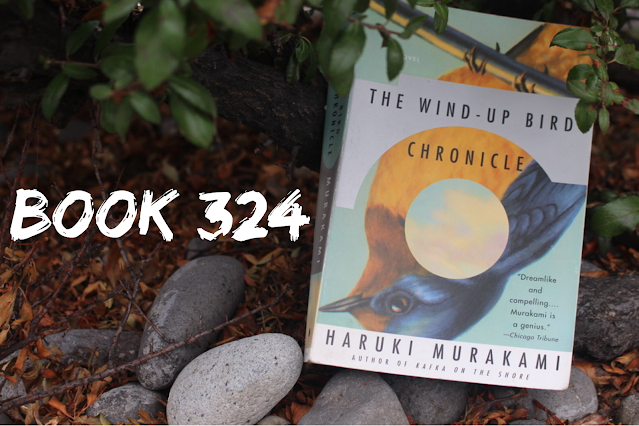
Book 324: The Wind-Up Bird Chronicle


"But even so, every now and then I would feel a violent stab of loneliness. The very water I drink, the very air I breathe, would feel like long, sharp needles. The pages of a book in my hands would take on the threatening metallic gleam of razor blades. I could hear the roots of loneliness creeping through me when the world was hushed at four o'clock in the morning." 

Dates read: June 27-July 5, 2019

Rating: 7/10

Lists/awards: 1001 Books You Must Read Before You Die

Sometimes I feel like living in the era of technology has robbed the world of its magic. Anyone with an internet connection can have access to what once were locals-only "secret" places. A rational explanation for something odd is almost always just a google away. You can have access to scads of information about almost anyone you meet in minutes. There's so little room left for actual mystery.

I remember reading somewhere that Haruki Murakami's books are among the most-stolen from bookstores. I'm not sure why that is, but there's no denying that the Japanese author has very devoted fans. Reading The Wind-Up Bird Chronicle was my first experience with him, and left me both sort of getting it and sort of not. It's a hard story to describe: there's a guy, Toru Okada, who lives outside of Tokyo with his wife, Kumiko, and their cat (which they've named Noboru Wataya, after her disliked brother) has gone missing. Toru has recently left his longtime job in a lawyer's office, but is unemployed while he tries to figure out what's next. Kumiko wants him to find the cat, and his searches for it lead him to strike up an acquaintance with a strange teenage girl, May, who lives down the block. That's when the phone calls start.

First, there's a woman who says she knows who he is and starts talking dirty to him. But then there's a psychic, a woman named Malta Kano, who explains that Kumiko has reached out to her to help with locating the cat. Kumiko and her family believe in things like psychics, having previously arranged for Kumiko and Toru to spend time with an old man called Mr. Honda, allegedly for spiritual consultations...but all that actually happens is that he repeatedly tells them about his experiences as a soldier in Manchuria during World War II. Toru meets with Malta Kano, and her sister, Cresta, but before long Kumiko herself disappears. She sends Toru a letter explaining that she's left him for a coworker with whom she's been having an affair, but he doesn't believe this and decides to try to find her, which brings him into contact with even more strange people, including a mother and son who he calls Nutmeg and Cinnamon. And appearing throughout is the sound of a bird, that sounds like something mechanical being wound.

This is a weird book, and I'm not sure I entirely understand it. It's one of those that you finish and almost want to flip right back to the beginning and start again, to see if it makes any more sense the second time through. I think there will be a second time through, though certainly not now. And there will definitely be more Murakami. If I had to chose a single word to describe it, it would be "dream-like". The way Murakami uses language and builds the world of the book create a feeling of constant loose connection, almost a structured free association, in which the concept that would tie everything together is just tantalizingly out of reach. It works well, and I found myself turning the pages and getting drawn further and further into it, though I suspected (correctly) that not everything was going to be tied up in a neat bow by the end.

Honestly, though, once I finished it, though I felt like I liked it, I have had a hard time articulating exactly why. It was obtuse, the female characters were largely underdeveloped (though I did love May), and it felt like some storylines were just dropped like hot potatoes. But despite its flaws, it's strangely compelling. There's something magical and mysterious about the world as Murakami creates it, and it did get me thinking about some of the deeper themes that were explored, like our obligations to each other as people and the nature of power in relationships. It's intellectually engaging despite the kind of haziness about it. If you're ready for something non-traditional, I would recommend this book.

One year ago, I was reading: Tooth and Claw

Two years ago, I was reading: Year of Wonders

Three years ago, I was reading: Delirium

Four years ago, I was reading: Boy, Snow, Bird

Five years ago, I was reading: Mrs. Dalloway

Six years ago, I was reading: Spinster

Thursday, October 28, 2021

Book 307: Princess Masako


"Here is an ambitious, intelligent woman who cannot bear the stifling constraints of life as a royal puppet; a woman from a family with a tradition of public service denied a real role in life; a woman with a Harvard education, a master of languages, who is denied meaningful discourse, and urged to amuse herself with pursuits such as the dissection of catfish or the study of medieval barges."

Dates read: April 3-7, 2019

Rating: 4/10

One of my guilty pleasures is royal-watching. I spend more time than I should reading about/looking at pictures of the world's royal families, analyzing their fashion choices, gazing longingly at their jewelry collections. It's not that I covet their lives, though I do covet many of their wardrobes, and just putting a tiara on my head once would be one of the highlights of my life. I've read the comments on the royal Instagrams, I've seen how nasty people are about the women in these families. It's just fun to imagine being one of them for a day, and then back to normal.

Though the British royal family sucks up most of the oxygen when it comes to coverage of royalty, it's not the oldest one. Not by a long shot. The oldest is the Chrysanthemum Throne, the seat of the Japanese emperors. Naruhito currently occupies that role, with his wife Masako filling the role of Empress. But like the women married to the British princes, Masako Owada wasn't born into nobility. She grew up in Russia, Japan, and the United States as the daughter of a diplomat. She herself even worked as a diplomat. But once she accepted then-Prince Naruhito's marriage proposal, her entire world changed. Unfortunately, as Ben Hill's Princess Masako explores, it hasn't always been necessarily for the better.

Allegedly, Masako didn't accept the first time Naruhito asked her to marry him. Nor even the second. She was smart enough to know that a life as the consort of the Crown Prince would require her to give up everything she'd earned for herself and accept a tightly circumscribed and entirely domestic role. It seems Naruhito promised her that they'd find a way to loosen restrictions and modernize, but those promises weren't able to be kept. Cut off from her former life and under immense pressure to get pregnant, Masako seems to have become significantly depressed. When she finally did become a mother, she faced a fresh round of criticism for having given birth to a girl instead of a boy, as only men can inherit the throne. Prior to her elevation to Empress, Masako basically became a recluse, appearing in public very infrequently.

There's a lot of (fairly educated) guesswork here, because sources about what Masako really thinks/feels aren't exactly forthcoming. Japanese media culture does not reward the sort of tabloid speculation that sells papers in Europe, and perhaps that is why it seems like Hill's sources were not as strong as one might have hoped. The people he talks to about Masako, who knew her before she became a princess, are either pretty far removed from their last contact with her or never knew her very well in the first place. A behind-the-scenes kind of book like this should feel rooted in firm reality with sources just remaining anonymous to protect themselves, but pretty much everything that's supposed to be revealing in here feels like speculation.

There's no sense of fun, either, which is half the point of picking up this sort of book. On the one hand, it's hard to imagine how this story could be anything but tragic, but on the other hand, letting that sense of sadness pervade the book makes the gossip-y tone feel like rubbernecking at a car accident. I did learn more about the Imperial Household Agency, the courtiers that control the royal family, and got a bit more context on the relationship between the Japanese people and their royalty, and the way it's changed in the post-WW2 era. But as a whole, the book never took off and I didn't feel like I got much besides a straightforward account of the biographical details of Masako's life. If you're really into the Japanese royals, then you might find something worthwhile here, but don't count on it for dishy intrigue. Otherwise, there's no real reason to pick it up.

One year ago, I was reading: Looking for Alaska

Two years ago, I was reading: Patron Saints of Nothing

Three years ago, I was reading: Seduction

Four years ago, I was reading: The Book Thief

Five years ago, I was reading: The Confessions of St. Augustine

Six years ago, I was reading: Primitive Mythology

Thursday, June 24, 2021

Book 290: A Tale For The Time Being


"But since these are my last days on earth, I want to write something important, too. Well, maybe not important, because I don’t know anything important, but something worthwhile. I want to leave something real behind."

Dates read: January 19-24, 2019

Rating: 8/10

I've never been able to regularly keep a diary. I did in middle school, and my mom found and read it, which meant I stopped. But even once I got old enough that the risk of someone else finding and reading my innermost thoughts was unlikely, I've never been able to get back in the habit even when I've tried. On the one hand, I wish I had a chronicle of my past, so I could go back and revisit my own record of my thoughts and feelings about the things that I've done and lived through. On the other hand, though, sometimes I'm glad that I don't have the option to do so. The things that are important, I've remembered. The things that maybe felt like a big deal at the time that have faded away...maybe there's a reason for that and it's better for me.

But not keeping a diary means that if something were to happen to me, my thoughts (besides those captured here!) would be lost forever. When Ruth finds the diary of a young Japanese woman washed up on the shore of her coastal Canadian town in Ruth Ozeki's A Tale for the Time Being, she assumes at first that it must be related to the tsunami. Of Japanese descent herself, Ruth (who shares virtually all of her personal details, including her name, the name and occupation of her husband, the small Canadian coastal island where she lives, and her profession as a writer with the author) starts reading it, intrigued by the life of diary-keeper Naoko, Nao for short. The teenager was born in Japan but mostly raised in America before her tech-industry-employee father loses his job and they go back to their homeland. She tells a tale of desperate unhappiness: behind in school, cruelly bullied by her classmates, worried about her father and his withdrawal from life. Her only comfort comes from her grandmother, a centenarian Buddhist nun called Jiko.

Ruth becomes more and more drawn in to Nao's story, distracting her from her own hopelessly mired writing project, a memoir based on caring for her mother in her end years, and drawing her more into the community on the island, which she's never felt connected to. She tries to find out more about Nao and her life, only to find herself mysteriously thwarted...until suddenly the boundaries between their times and worlds begin to blur. Can Ruth somehow save Nao, if in fact Nao needs saving? And can she find a way to solve her own existential crises?

I'm not always a fan of split narratives, since I think one side of the story almost always ends up being more compelling than the other(s). And there was a little bit of that here...Ruth's story wasn't especially boring or anything, but Nao's pieces were so much more interesting that I groaned a little bit internally when things went back to Ruth. And writing about writers (especially when that writer character is heavily based on the author themselves) often veers towards self-indulgence. Again, there was a little of this going on, but not to the extent that it dragged the story down past being mildly irritating every so often. It also steps into magical realism and meta-narrative when Ruth and Nao's stories intersect across time and space, and while the emotional truth of it comes through I'm not sure that it was entirely successful.

Basically, the book takes on a lot of potentially dicey elements and executes them competently-to-well, but not greatly. Even so, there's a lot to like here and I found it an intensely readable book, getting drawn into the mystery of what might have happened to Nao and whether Ruth would ever be able to find out. While I was certainly more engaged with Nao's story, Ruth was also a compelling character, and her issues were less dramatic but no less well-developed. The book is quite long, but it's paced well and doesn't drag or feel padded. It's easy to get drawn in and hard to put down, and feels like it will reward re-reading. Just as a heads up to readers, this book features a lot of very dark things, including merciless bullying and sexual assault, happening to a teenage girl and might not be the best choice for readers not ready for this kind of material for any reason. If you're able to deal with that, though, this is a very good book that doesn't quite get to greatness but is nevertheless a worthwhile read.

One year ago, I was reading: Queen of the Tearling

Two years ago, I was reading: American Psycho

Three years ago, I was reading: The Feast of Love

Four years ago, I was reading: Spook

Five years ago, I was reading: The Relic Master