Showing posts with label amsterdam. Show all posts

Thursday, February 17, 2022

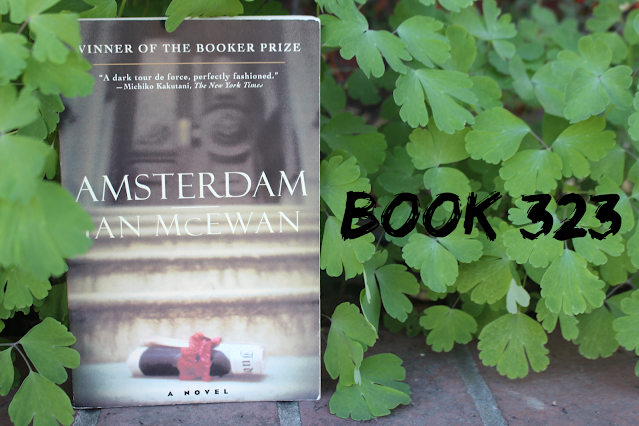
Book 323: Amsterdam


“As far as the welfare of every other living form on earth was concerned, the human project was not just a failure, it was a mistake from the very beginning.”

Dates read: June 25-27, 2019

Rating: 6/10

Lists: Booker Prize, The New York Times best-seller

Few things are more satisfying than boiling hot self-righteousness. If there's a drug that gives you that feeling of someone else being not just incorrect, but morally wrong, and being about to shove it in their face that you're a better person than they are, please no one tell me. I will become an addict. Of course, we all know that it is almost inevitably followed by realizing that you are not quite in fact as heroic as you felt, nor is the other person the literal spawn of Satan. But it's a heady rush while it lasts.

Even long-standing friendships aren't immune from misunderstanding and resentments. In Ian McEwan's Amsterdam, two old friends meet at the funeral of a woman they each had loved once. But it isn't the free-spirited Molly, now gone after a brief but terrible bout of dementia, that drives apart Vernon, the editor of a struggling London newspaper, and Clive, a respected composer. They've long since come to terms with that part of their lives. Neither of them can much understand what she ever saw in another one of her former lovers, who also attends the funeral: Julian, a conservative politician whose policy stances would seem to be anathema to Molly's guiding principles of love and acceptance. Nor can they understand why she married George, who seemed bent on controlling her and molding her into conventional respectability. Like many friends, Vernon and Clive have gone through cycles of being more or less close over the years, and the funeral pushes them back into each other's orbit. Spooked by the circumstances of Molly's death, each promises that if the other were to be in a similar state of decline, they would help the end come quicker.

Not long afterwards, both men find themselves in a position to have to make a moral choice. Vernon is given photographs that Molly took of Julian during their relationship...photos that his support base would find shocking. These photos would solidify Vernon's position at the paper by boosting circulation and catapult him into the spotlight after a lifetime of toiling away in relative obscurity. Clive has received a prestigious government commission to compose a piece to celebrate the millennium, and struggles for inspiration until, when taking a hike while out of town, he sees a man attack a woman on the trail. Finding himself suddenly able to see where he wants his symphony to go, he ignores the situation and doesn't report what he saw to the police. Clive is aghast that Vernon would even consider publishing the photos of someone else's private, intimate moments. Vernon is insistent that Clive report what he saw and face responsibility for his failure to intervene on behalf of the woman and keeping what he witnessed from law enforcement. The two are bitterly estranged.

This book is so short as to practically be a novella. That doesn't limit the impact of McEwan's satire, though. If you have ever known a pompous middle-aged man, Vernon and Clive are pitch-perfect. Both ruminate on the clarity of the situation facing the other, while running themselves ragged in the mental gymnastics required to justify their own choices. Each can only see the ways in which they themselves have been good, devoted friends, while the other has taken advantage of their generosity. But that's kind of one of the issues: character. While obviously something this brief and with this perspective isn't out for a deep character study, Vernon and Clive are basically the same person. And George, who shows up to create havoc throughout, seems more like a plot device than a human. I never found anyone compelling enough to really care about how it would end up.

How it ends up is a little too tidy and convenient, for that matter. And the pacing is odd...it drags and feels bloated (despite its brevity) in places, but the conclusion feels rushed. It's not without its clever moments and witty turns of phrase, but it really feels like an excellent short story concept that got padded into a decent-but-unspectacular short novel. It's worth a try (the upside of having such a low page count is that even if it doesn't work, it shouldn't take long to finish), but there are sharper, funnier satires out there. 

One year ago, I was reading: The Eyre Affair

Two years ago, I was reading: The Year of Reading Dangerously

Three years ago, I was reading: Daisy Jones & The Six

Four years ago, I was reading: My Name is Venus Black

Five years ago, I was reading: Nefertiti

Six years ago, I was reading: The Namesake

Sunday, June 30, 2019

A Month In The Life: June 2019


My life! I have one again! This month saw the end of legislative session and while it was a good one for me, with lots of professional growth, hot damn was it a struggle near the end. But now it is over until 2021! I'm hoping my reading pace picks up, I'm behind where I was even two years ago, the last time I went through session!

In Books...

  • Delirium: Reading this at the end of session, when my brain was exhausted, was the best possible time to do so. If I was ever going to be receptive to a young adult dystopia about a world where love is considered a deadly disease, this was it. I didn't think it was especially good, it indulged in a lot of cliches, but it held my attention and interest reasonably well.
  • Good Riddance: While the previous book was fun fluff, this was just offensively dumb fluff. The potential was there in the concept, of a woman who tosses her mother's annotated yearbook in the trash only to find a neighbor has rescued it and wants to make it into a documentary, but the execution was awful. The plot was silly, the characters were flat...a waste of time.
  • There There: I'd heard rave reviews of this book, so I was super happy when it was selected for my book club. And while Tommy Orange's writing is often breathtakingly good and he sketches vivid characters through short vignettes, I found myself frustrated with the structure. It's basically interconnected short chapters from many points of view and I wanted a more cohesive narrative for what could have been an amazing novel but was ultimately a very good one instead.
  • The Coming Plague: This book, about the impact of human behavior on the diseases that we experience, was fascinating! It also was a little too long...at over 600 pages of text in relatively small type, there was a point at which even the well-told and interesting stories about the emergence of "new" diseases like Ebola, AIDs, and Legionnaire's Disease (among many others) gets old.  
  • American Psycho: The satire of the soullessness of 80s consumer culture/Wall Street bankers is devastatingly, perfectly sharp. But this is beyond a doubt one of the most disturbing books I've ever read. Even just skimming the sex/violence I still read things that it's going to take me quite a while to get out of my head. 
  • Amsterdam: I picked this up because it had won the Booker Prize, and now that I've read it, I have no idea why it did. It's cleverly written, and amusing in the way it skewers the delusions of grandeur of two old friends who reconnect at the funeral of a woman they both once dated. But it didn't make much impact on me, and I doubt I'll remember it for more than a couple months.


In Life...
  • Session is over: My fourth time through legislative session wrapped up early in the month and it wasn't a minute too soon! I'm very much enjoying having an 8-minute walk to work instead of a 40-minute drive, going home at lunch to hang out with my husband and dog, and being home at a reasonable hour every night. Also the enormous lessening of the stress burden. And we've started playing pub trivia!

One Thing:

Like many people recently, I was sucked into and fascinated by HBO's excellent docudrama Chernobyl. If you haven't seen it, I highly, highly recommend it. And either way, I'd recommend this fascinating article about women who have moved back into the Exclusion Zone. The piece is several years old now but I find this dilemma really interesting: if you're older, and you've spent your whole life living in one place and don't want to leave it, accepting the risks of staying...should anyone be able to make you go?

Gratuitous Pug Picture:

Tuesday, June 25, 2019

Top Ten Tuesday: Books On My Summer 2019 TBR

Top Ten Tuesday is a weekly linkup of book bloggers hosted by That Artsy Reader Girl! This week, we're bringing to you our summer reading. I've always maintained that my summer reading are just books I happen to read in the summer, so these are mostly not breezy or beachy.


Amsterdam: This is a Booker Prize winner, one of the prizes that my own tastes tend to track most strongly with.

The Wind-Up Bird Chronicle: I've never read Murakami, so this giant book is going to be a trial run. Hopefully I like his writing!

Washington Black: I'm not sure about this book club pick...it's gotten lots of praise, but "adventure story" is not something that usually does it for me.

Polite Society: I have an ARC of this Indian twist on Emma, which actually does sound like a fun summer read!

Nickel and Dimed: Systemic poverty is a buzzkill, but it's important to be educated about.

The Man in the High Castle: I like alternative histories, and I loved Do Androids Dream of Electric Sheep when I read it in high school, so hopefully I still enjoy Phillip K Dick?

How to be Good: I really like reading Hornby novels. They're pleasant and funny and I don't have to think too hard.

Sashenka: I have fallen hard into a Russia/Soviet Union obsession lately, so an epic about a woman's life beginning before the fall of the Romanovs and continuing through the Soviet era is right up my alley.

Money Rock: This is a nonfiction look at the life of a drug dealer in North Carolina, and the broader social forces that have impacted him and his family. I get a lot out of books that talk about broader movements through looking at particular people's lives.

Marie Antoinette: Royalty!