Showing posts with label literature in translation. Show all posts

Thursday, June 2, 2022

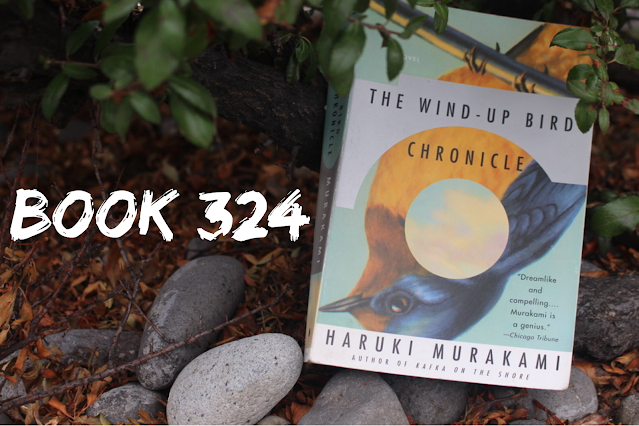
Book 324: The Wind-Up Bird Chronicle


"But even so, every now and then I would feel a violent stab of loneliness. The very water I drink, the very air I breathe, would feel like long, sharp needles. The pages of a book in my hands would take on the threatening metallic gleam of razor blades. I could hear the roots of loneliness creeping through me when the world was hushed at four o'clock in the morning." 

Dates read: June 27-July 5, 2019

Rating: 7/10

Lists/awards: 1001 Books You Must Read Before You Die

Sometimes I feel like living in the era of technology has robbed the world of its magic. Anyone with an internet connection can have access to what once were locals-only "secret" places. A rational explanation for something odd is almost always just a google away. You can have access to scads of information about almost anyone you meet in minutes. There's so little room left for actual mystery.

I remember reading somewhere that Haruki Murakami's books are among the most-stolen from bookstores. I'm not sure why that is, but there's no denying that the Japanese author has very devoted fans. Reading The Wind-Up Bird Chronicle was my first experience with him, and left me both sort of getting it and sort of not. It's a hard story to describe: there's a guy, Toru Okada, who lives outside of Tokyo with his wife, Kumiko, and their cat (which they've named Noboru Wataya, after her disliked brother) has gone missing. Toru has recently left his longtime job in a lawyer's office, but is unemployed while he tries to figure out what's next. Kumiko wants him to find the cat, and his searches for it lead him to strike up an acquaintance with a strange teenage girl, May, who lives down the block. That's when the phone calls start.

First, there's a woman who says she knows who he is and starts talking dirty to him. But then there's a psychic, a woman named Malta Kano, who explains that Kumiko has reached out to her to help with locating the cat. Kumiko and her family believe in things like psychics, having previously arranged for Kumiko and Toru to spend time with an old man called Mr. Honda, allegedly for spiritual consultations...but all that actually happens is that he repeatedly tells them about his experiences as a soldier in Manchuria during World War II. Toru meets with Malta Kano, and her sister, Cresta, but before long Kumiko herself disappears. She sends Toru a letter explaining that she's left him for a coworker with whom she's been having an affair, but he doesn't believe this and decides to try to find her, which brings him into contact with even more strange people, including a mother and son who he calls Nutmeg and Cinnamon. And appearing throughout is the sound of a bird, that sounds like something mechanical being wound.

This is a weird book, and I'm not sure I entirely understand it. It's one of those that you finish and almost want to flip right back to the beginning and start again, to see if it makes any more sense the second time through. I think there will be a second time through, though certainly not now. And there will definitely be more Murakami. If I had to chose a single word to describe it, it would be "dream-like". The way Murakami uses language and builds the world of the book create a feeling of constant loose connection, almost a structured free association, in which the concept that would tie everything together is just tantalizingly out of reach. It works well, and I found myself turning the pages and getting drawn further and further into it, though I suspected (correctly) that not everything was going to be tied up in a neat bow by the end.

Honestly, though, once I finished it, though I felt like I liked it, I have had a hard time articulating exactly why. It was obtuse, the female characters were largely underdeveloped (though I did love May), and it felt like some storylines were just dropped like hot potatoes. But despite its flaws, it's strangely compelling. There's something magical and mysterious about the world as Murakami creates it, and it did get me thinking about some of the deeper themes that were explored, like our obligations to each other as people and the nature of power in relationships. It's intellectually engaging despite the kind of haziness about it. If you're ready for something non-traditional, I would recommend this book.

One year ago, I was reading: Tooth and Claw

Two years ago, I was reading: Year of Wonders

Three years ago, I was reading: Delirium

Four years ago, I was reading: Boy, Snow, Bird

Five years ago, I was reading: Mrs. Dalloway

Six years ago, I was reading: Spinster

Thursday, April 27, 2017

Book 74: Masha Regina

 
"The wind of time blows in two directions. It's the rare person who feels its current parallel to his ongoing life. It's a special skill to catch time wafting, from the future, on your cheeks. In the emptiness between the train carriages, Masha felt- her fingers went icy from the certainty of that sensation- as though those ten minutes on the jolting train carriages, with her on one side and the boy on the other, would become a sort of tuning fork for her happiness."

Read: July 29-August 1, 2016


Rating: 7/10

I can't imagine how hard it must be to be a professional translator, especially for literature. I took two years of Italian in college, and even the simple school exercise of translating song lyrics was rendered often frustrating because of the inability to directly translate in a way that makes actual sense. Even something as simple as "I miss you" (mi manchi) literally translates as "you are missing to me". It's essentially the same thing, but it takes the focus from I to you, making it feel softer somehow (at least in my overly romantic brain). Translating an entire book? Eep.

Translating Vadim Levental's Masha Regina must have been an especially delicate endeavor, so props to Lisa Hayden. Levental spent five years writing the book and it's obvious that he chose each word carefully. Hayden's translation is lush and evocative...obviously I can't read it in the original Russian, but it's hard to believe that it suffered any real loss being taken into English. Masha Regina is the story of the titular woman (her given name is actually Maria, but she's almost exclusively referred to by her nickname during the course of the novel), from about the time she's a teenager to well into her adulthood. It's hard to tell how old she's supposed to be by the end, exactly, because the novel progresses in a loosely linear way but with lots of digressions backwards and forwards and it can be hard to tell at any given moment where we are in Masha's life. It works when you're reading it, as long as you're paying attention, but it makes it hard to summarize the novel in a straightfoward way.

I do love a good summary, though, so I'll take a crack at it. Masha is an artistically gifted teenager living in a small, decaying town in the Russian countryside. She doesn't necessarily know what she wants, but she knows she doesn't want to get stuck there like her parents, and when she's probably about 15 she manages to get her parents to send her to St. Petersburg to go to boarding school. On the train to the city, she meets Roma, another teenager who's heading back to his own studies in the city. He helps her get to her school and she falls a little bit in love with him, which she continues to be even as she has a long-term relationship with one of her teachers and he rejects her when she comes to see him. It's only later in their lives, after they've graduated and begun working towards careers in filmmaking (she as a director, he as a cinematographer) that they finally get together and become romantically as well as professionally involved. Their relationship is tempestuous, and Masha becomes pregnant with their child shortly before she leaves him for good, taking up with an older German actor while he romances a former school friend of hers.

Although it's Masha's story and she's a fascinating character to spend a couple hundred pages with, it's never quite clear what drives her. At the beginning it's a desire to escape the drudgery she's surrounded with, which she does both through art and eventual literal escape. And then it's a desire to stay escaped, working her way to catch up with school so she can stay in St. Petersburg, building a name for herself as a director. But once she's got a solid career, her artistic expression seems almost more like a compulsion than a drive or a passion. The cool shell she built herself to keep her propelling through her early life eventually traps her...she doesn't know how to deal with adversity besides creating a film and throwing herself into the making of it.

As I read, I found myself mostly focusing on the way fate seems to play a role in the construction of a life...Masha's life particularly, but all our lives, really. Masha's chance connection on the train with Roma as a teenager reverberates through her entire life. She gets into directing after accompanying a friend to an audition for an acting graduate program. I know how in my own life, my trip to Nevada was supposed to be a three-month thing until I met my husband doing voter registration. The big things matter, of course, but the little coincidences of our lives can be even more meaningful, in the end. Masha Regina is beautifully written (maybe a little overwritten) and mostly pretty compelling, but the sum of its parts is more than the whole, somehow.

Tell me, blog friends...what little things ended up making a big difference in your life?

One year ago, I was reading: The President's Club