Thursday, February 17, 2022

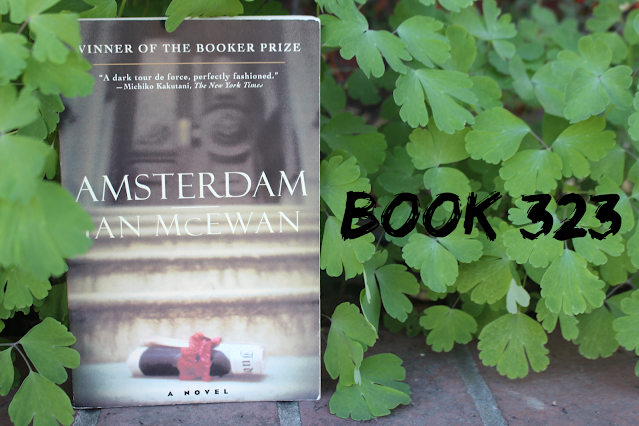
Book 323: Amsterdam


“As far as the welfare of every other living form on earth was concerned, the human project was not just a failure, it was a mistake from the very beginning.”

Dates read: June 25-27, 2019

Rating: 6/10

Lists: Booker Prize, The New York Times best-seller

Few things are more satisfying than boiling hot self-righteousness. If there's a drug that gives you that feeling of someone else being not just incorrect, but morally wrong, and being about to shove it in their face that you're a better person than they are, please no one tell me. I will become an addict. Of course, we all know that it is almost inevitably followed by realizing that you are not quite in fact as heroic as you felt, nor is the other person the literal spawn of Satan. But it's a heady rush while it lasts.

Even long-standing friendships aren't immune from misunderstanding and resentments. In Ian McEwan's Amsterdam, two old friends meet at the funeral of a woman they each had loved once. But it isn't the free-spirited Molly, now gone after a brief but terrible bout of dementia, that drives apart Vernon, the editor of a struggling London newspaper, and Clive, a respected composer. They've long since come to terms with that part of their lives. Neither of them can much understand what she ever saw in another one of her former lovers, who also attends the funeral: Julian, a conservative politician whose policy stances would seem to be anathema to Molly's guiding principles of love and acceptance. Nor can they understand why she married George, who seemed bent on controlling her and molding her into conventional respectability. Like many friends, Vernon and Clive have gone through cycles of being more or less close over the years, and the funeral pushes them back into each other's orbit. Spooked by the circumstances of Molly's death, each promises that if the other were to be in a similar state of decline, they would help the end come quicker.

Not long afterwards, both men find themselves in a position to have to make a moral choice. Vernon is given photographs that Molly took of Julian during their relationship...photos that his support base would find shocking. These photos would solidify Vernon's position at the paper by boosting circulation and catapult him into the spotlight after a lifetime of toiling away in relative obscurity. Clive has received a prestigious government commission to compose a piece to celebrate the millennium, and struggles for inspiration until, when taking a hike while out of town, he sees a man attack a woman on the trail. Finding himself suddenly able to see where he wants his symphony to go, he ignores the situation and doesn't report what he saw to the police. Clive is aghast that Vernon would even consider publishing the photos of someone else's private, intimate moments. Vernon is insistent that Clive report what he saw and face responsibility for his failure to intervene on behalf of the woman and keeping what he witnessed from law enforcement. The two are bitterly estranged.

This book is so short as to practically be a novella. That doesn't limit the impact of McEwan's satire, though. If you have ever known a pompous middle-aged man, Vernon and Clive are pitch-perfect. Both ruminate on the clarity of the situation facing the other, while running themselves ragged in the mental gymnastics required to justify their own choices. Each can only see the ways in which they themselves have been good, devoted friends, while the other has taken advantage of their generosity. But that's kind of one of the issues: character. While obviously something this brief and with this perspective isn't out for a deep character study, Vernon and Clive are basically the same person. And George, who shows up to create havoc throughout, seems more like a plot device than a human. I never found anyone compelling enough to really care about how it would end up.

How it ends up is a little too tidy and convenient, for that matter. And the pacing is odd...it drags and feels bloated (despite its brevity) in places, but the conclusion feels rushed. It's not without its clever moments and witty turns of phrase, but it really feels like an excellent short story concept that got padded into a decent-but-unspectacular short novel. It's worth a try (the upside of having such a low page count is that even if it doesn't work, it shouldn't take long to finish), but there are sharper, funnier satires out there. 

One year ago, I was reading: The Eyre Affair

Two years ago, I was reading: The Year of Reading Dangerously

Three years ago, I was reading: Daisy Jones & The Six

Four years ago, I was reading: My Name is Venus Black

Five years ago, I was reading: Nefertiti

Six years ago, I was reading: The Namesake

Thursday, February 10, 2022

Book 322: American Psycho


"There wasn’t a clear, identifiable emotion within me, except for greed and, possibly, total disgust. I had all the characteristics of a human being—flesh, blood, skin, hair—but my depersonalization was so intense, had gone so deep, that the normal ability to feel compassion had been eradicated, the victim of a slow, purposeful erasure. I was simply imitating reality, a rough resemblance of a human being, with only a dim corner of my mind functioning. Something horrible was happening and yet I couldn’t figure out why—I couldn’t put my finger on it." 

Dates read: June 21-25, 2019

Rating: 6/10

The trouble with having grown up prior to the YA boom is that when I was a teenager, once you ran out of the Lois Duncan, R.L Stine, and Sweet Valley High books, there wasn't a lot left. That's a bit of an oversimplification (the excellent Speak came out when I was in 9th grade, and obviously the Harry Potter series as well), but not too much. So I read a lot of adult literature. Some of which was just too complicated for me (I gave up about 60 pages into Anna Karenina), some of which went over my head, but a lot of which enriched my mind and expanded my boundaries! As a result of that experience, I've always been strongly opposed to any sort of censorship of teen reading...making sure you know what your kid is reading and talk to them about it, sure, but the reading is the important part.

I didn't think I would ever read anything that would make me think that an age restriction for a book could be realistically justified. And then I read Bret Easton Ellis's American Psycho. Patrick Bateman (older brother of The Rules of Attraction's Sean Bateman) is a New York City banking bro in the 1980s. It would seem like he has a pretty great life: his job is prestigious and pays well, he has a pretty fiancee, he works out regularly and is in good shape, he has a nice apartment. But what Patrick also has going on is a gnawing emptiness at his center, and violent urges he's not quite able to control. He lashes out at first against the powerless: poor people, prostitutes. But his need to hurt people escalates farther and farther until he's committing actual atrocities against even people he knows, while somehow still trying to keep it together enough to go to work and live his life as normally as possible.

I'm not usually overly puritanical about depictions of sex and violence in books. Sex and violence are (fortunately and unfortunately, respectively) parts of life. And I'd seen the movie! I thought I had a handle on what was in store. But this book doesn't just flounce right over the line of being gratuitous, it goes into actively stomach-churning territory. There are things I read in this book that gave me pictures in my head I will never unsee and honestly gave me heaves. And part of it, I think, is deliberate...besides being just gross, the book is also a razor-sharp satire. A recurring motif are Bateman's much-stressed-about trips to the video store, where he rents violent pornography which desensitizes him both towards normal sex and violence against women. Living in a culture where depictions of outlandish acts of sex and violence are easy to access means that it requires yet more extreme examples to achieve the titillating/disturbing effect...examples, of course, that the text itself provides. It's clever, if also very off-putting.

I had a really hard time deciding how I felt about this book. As a cutting send-up of the consumer culture of the 1980s, particularly in the heart of the NYC finance scene, it was extremely effective and often entertaining. The agonies about getting a table at the latest bougie restaurant serving the most unappetizing-seeming "exotic" food combinations were dead on. The way the book played with identity, with Patrick both constantly mistaking people he sees for people he knows and being wrong, and himself being called by the incorrect name, because as seriously as he takes his outfits (most of which are described in detail), the end result is that he looks just like everyone else, was smart and insightful. I would be pulled in and admiring the craft of it...and then there would be a gruesome murder and I would pulled back out again.

Even just skimming much of the over-the-top portions of the book (it gets worse and worse as it goes along), it was a reading experience I found really difficult. This book has age restrictions for access in several countries, and I'm actually not mad about it. I might have found one of the few things I actually don't think a teenager should read without an adult having to be a part of the process. I don't know that I would affirmatively recommend that anyone read this book, it's that messed up. Which is a pity, because the parts of it that are satirical are incredibly well-executed (pun sort-of intended) and effective. But the rest of it is just too much. Yes, it's worse than the movie. Much, much worse. If your interest in still piqued and you have an iron stomach, there is merit here. But be prepared. 

One year ago, I was reading: The Leftovers

Two years ago, I was reading: The Lives of Tudor Women

Three years ago, I was reading: Forest Dark

Four years ago, I was reading: Wonder Boys

Five years ago, I was reading: Between the World and Me

Six years ago, I was reading: Ahab's Wife

Thursday, February 3, 2022

Book 321: The Coming Plague


"Overall, Swine Flu and Legionnaires' Disease boiled down to the same set of troubling perceptions for the American public, and, to a lesser extent, the Canadian, Mexican, Australian, New Zealand, and European publics: something new and very scary was coming; nobody was sure what it was, but the experts were certain it was dangerous; the federal government seemed quite distressed about the matters, but the experts and authorities didn't seem to agree as to what, if anything, should be done to protect the public; and it was all costing taxpayers a pretty penny. In both cases, public apprehension would eventually yield to impatience and allegations of incompetence, even scandal."

Dates read: June 10-21, 2019

Rating: 7/10

I just want to kick off this review by noting that I read this book well before "covid" was a string of letters I'd ever think to put together. I considered going back and re-writing this based on what we know now, but I thought it was more genuine to preserve my reaction to the book as of the time I read it. Anyways! Of all the times I've ever been sick, I don't know that anything has been as unpleasant as the times I've had the simple flu. The soaring fevers, the aches, the blocked up sinuses that make sleep so difficult...it's several days of feeling just utterly wretched, followed by several more where you just feel weak like a kitten. But of course, I've never been really sick. I've had the odd bout with pneumonia, which I also do not recommend, but generally I've been in good health. I do appreciate living in the world of antibiotics.

Once upon a time, a simple strep throat or upper respiratory infection could literally kill you. And it wasn't even that long ago, really! Penicillin was discovered less than 100 years ago. What it might be like to return to a world in which there were not effective antibiotics is one of the many topics covered in Laurie Garrett's The Coming Plague. In this large volume, Garrett investigates how the world continues to be vulnerable to infection, the consequences we might face for the widespread overuse of antibiotics in the modern world, and the way in which our own actions continue to bring us into contact with new agents of disease. She takes a broad look at trends in epidemiology: the emergence of Ebola, the discovery of Legionnaire's Disease, toxic shock syndrome, and of course, the spread of AIDS. And she doesn't shy away from an examination of the underlying systems that help perpetuate the spread of infection, particularly among the poor.

I found the most compelling portion of the book to be its examination of the AIDS crisis. I came of age in a world where AIDS was just a fact, and this is the first time I really got a sense of the fear that the beginning of the epidemic created. Hemophiliacs and gay men just...dying, in large and inexplicable numbers. The way that no one knew what was happening, or how this new disease spread, and (heartbreaking) the difficulty of getting government systems, controlled by conservative Republicans, to care about an illness that was affecting a group of people that they were just not interested in helping. There's an urgency there which really comes across strongly and made it hard to put down.

Garrett is a journalist by trade, and it shows in the writing of the book. The Coming Plague is strongest when she's focusing less on the recitation of facts (like she does when she talks about the process through which some microbes become antibiotic resistant, which feels like struggling through a science class) than on telling a story about people. There are some dynamic personalities, like Dr. Joe McCormick, that show up again and again in the fight against emerging infections, and this work shines when she lets them and the patients they treat take center stage. For the most part, she does keep the focus on people and the systems in which they operate in a way that keeps the book moving along, but it does occasionally bog down when she tries to get too heavily scientific, and in a book this long, it's a tricky bog to escape from.

I found myself wondering as I was reading this book who exactly Garrett had in mind as the target audience. It's got over 600 pages of text before endnotes, and the print on those pages is not large. It seems too long, and too detailed, to get wide traction in the general population of readers. But it's not scholarly or academic in nature, either. I'm a reader who is prepared to do some intellectual work, especially when reading nonfiction, and by the time I had only 150 pages left I was ready to be done even though the material I was reading was just as good as what had come before it. If she'd cut out some of the more science-oriented material, I think it would have kept the book moving better and more accessible to readers. As is, this is good, particularly if you have any interest in epidemiology, but feel free to skim through the more dense portions if they're not catching your interest. 

One year ago, I was reading: The Secret Life of Bees

Two years ago, I was reading: Whores of the Devil

Three years ago, I was reading: The Mind's Eye

Four years ago, I was reading: Thank You For Smoking

Five years ago, I was reading: Orange is the New Black

Six years ago, I was reading: Creative Mythology

Tuesday, February 1, 2022

Top Ten Tuesday: Books with Character Names In the Titles

Top Ten Tuesday is a weekly linkup of book bloggers hosted by That Artsy Reader Girl! This week, we're talking about books with character names in the titles. I've pulled these ones off my to-be-read list, and honestly it seems like this was more of a thing with the classics? SO many old books are named after their main characters!


Madame Bovary

The Last Temptation of Christ

Frankenstein 

Jonathan Strange and Mr. Norrell

Dr. Jekyll and Mr. Hyde

Violet & Claire

The Brothers Karamazov 

What Ever Happened to Baby Jane?

Doctor Zhivago 

Hild

Monday, January 31, 2022

A Month in the Life: January 2022


I'm not even pretending with the new-year-new-me stuff in 2022, y'all. The world is still in the depths of a pandemic that has so profoundly disrupted our lives that the "normal" I once imagined getting back to feels strange. I'm going to have a baby in the next few weeks here at some point. I have no idea what my life is going to look like three months from now, much less at the end of the year. I'm just here to keep on keepin' on.

In Books...

  • Beyond The Pale: This was an impulse Kindle sale purchase, written by a folklorist about having a child with albinism. I thought it was going to take a more academic view of the condition, but it's a pretty standard "sick kid" memoir about coming to terms with the diagnosis and exploring her own family history to discover where it might have come from. I found it pretty boring.
  • A Long Way Down: Another Nick Hornby I found disappointing. This one tells the story of four strangers who meet on a rooftop that they've all come to jump from, and the subsequent tensions between them after they decide not too. The problem is that those conflicts don't really grow or change, just repeat, and virtually none of his characters is actually compelling. Dialogue, as always, is a high point but it's about the only one.
  • Tender Is The Night: I wish this classic, which I read for book club, was a straight-up depiction of the extremely complicated relationship between F. Scott Fitzgerald and his wife Zelda instead of a thinly-veiled one. It's good, honestly, but not nearly as good as Gatsby.  
  • Olga Dies Dreaming: This started so well, with the story of two 40-something siblings of Puerto Rican descent living in New York living outwardly successful lives while continuing to reckon with the pain of their mother's abandonment when they were teens to pursue revolution catching me almost immediately with wit and well-drawn characters. It lets its storytelling fall by the wayside for a bit in the middle in favor of info dumps, but the ending was pretty strong. 
  • Feminist Theory, From Margin to Center: I'd never read bell hooks before, or taken any sort of gender studies course. This is an excellent book, which meaningfully conveys the major issues feminism as a movement was confronting at the time it was written (1984) in a way that's both rigorous and accessible. It was also kind of infuriating to realize how much these issues still plague the women's movement, nearly 40 years later.  
  • Northanger Abbey: This was my last unread Austen! It's interesting that it's one she apparently wrote when she was younger, though it wasn't published until after she died. Its humor is less sophisticated, broader, but honestly in many ways just as if not more actually enjoyable for all that. And I think Henry Tilney might be my favorite of the Austen men.


In Life...

  • Last full month before parenthood: It's hard to believe that by the end of next month, I'll have a baby! I can imagine few things less pleasant than going into labor while Covid-positive, so I've been kind of a hermit lately and go few places other than to the store.

One Thing:

Being extremely pregnant is extremely uncomfortable! A surprising number of my pre-pregnancy tops still fit, but bottoms are another story. My beloved Old Navy leggings are still going strong for daytime wear, but at night...leaving the waistband untied is not really cutting it anymore in the late months. I'm not sure how long they'll hold up, but these Amazon Essentials lounge pants have been my lifesaver for just hanging out being cozy at home. They are not thick or luxurious, but they're comfortable and have pockets and to be honest that's enough right now.

Gratuitous Pug Picture:


Thursday, January 27, 2022

Book 320: There There


"He moves in front of the mirror and his feathers shake. He catches the hesitation, the worry in his eyes, there in the mirror. He worries suddenly that Opal might come into the room, where Orvil is doing..what? There would be too much to explain. He wonders what she would do if she caught him. Ever since they were in her care, Opal had been openly against any of them doing anything Indian. She treated it all like it was something they could decide for themselves when they were old enough. Like drinking or driving or smoking or voting. Indianing." 

Dates read: June 7-10, 2019

Rating: 8/10

Lists/awards: American Book Award

DNA tests can do cool things these days. Not only does mine show me that I'm part Polish, it can even identify the area in Poland where my family came from! Does it actually matter, at the end of the day? Well, no. If I ever do visit Poland, it would almost certainly be to go to one of the major cities, not the tiny village in Podkarpackie Voivodeship that my great-grandfather left over a century ago. But it's interesting to be able to confirm that tie to the past, to get a better sense of where I come from and what my family's story is.

For Native Americans living on reservations in a community that includes elders, a sense of connection with the past is probably more tangible. But of course, that's not where all Native Americans live. Plenty of them live in cities, and it's an attempt to put together a pow-wow in Oakland that brings together the characters of Tommy Orange's debut novel, There There. Through changing point-of-view chapters from a wide cast, the book tells the story of how the pow-wow brings people together in unexpected ways...and what happens when a group of young men eye the prize money for the dance competition as a target for robbery. Common throughout are the questions the characters have about identity, and what it means to be an Indian in a large city.

The character wrestling most with identity and meaning is Dene Oxendene, who wins a competition for grant money that he intends to use to record Indian people telling their own stories about their lives. He sees the pow-wow as an opportunity to film many people at once. But there's also Edwin, whose interest in participating in the event, and breaking out of his self-imposed social isolation, is sparked by the discovery of his Indian father via social media. The internet is also how teenage Orvil tries to connect with his culture, as his stern grandmother Opal Viola Victoria Bear Shield (who was taken to the AIM takeover of Alcatraz as a child, along with her sister Jacquie Red Feather, by their unstable mother) who is raising him and his brothers refuses to talk about being Indian with them. Orvil learns tribal dances from YouTube, and plans to enter the dance competition. But the internet also provides a group of young men (including Tony Loneman, angry at the scorn he's received because of his fetal alcohol syndrome) with the schematics to 3D print guns from plastic that could be snuck past the metal detectors at the pow-wow, so they can get money to remedy a drug deal gone wrong.

Tommy Orange is a dazzling talent and this is a very good book. I would say that the only thing holding it back from greatness, for me, is that I wished it was told with a more traditional story structure. While each character's perspective was distinct and important, I found it hard to keep track of who everyone was in relation to everyone else, and a more well-delineated central narrative thread would have, for me, made the book's impact even more powerful. But the reality is that it's powerful anyways. I really cannot overstate how good Orange's writing is. These characters feel like they actually exist in the world, like each one of them, no matter how small a part they play, have full lives and histories that we're only able to get hints of. He switches back and forth between first- and third-person perspective, and even writes one chapter in the second person, which didn't add anything narratively as far as I was concerned as much as feeling like the exuberance of an artist pushing at the boundaries of what he can do.

In a way, this felt like an answer to one of the most well-known writers of Native American adult literature today: Louise Erdrich. While Erdrich's work focuses primarily on women, particularly older women, on reservations in the northern Great Plains, Orange's novel highlights men, especially young men, in a large Californian city. What they share is a story structure in which there are multiple characters that are the focus of one chapter at a time in a non-chronological narrative, as well as a focus on how to live in the world as an Indian today. Erdrich, who has won the National Book Award and been a finalist for the Pulitzer Prize, is a big name to invite comparisons with, but Orange lives up to it. This book is a must-read, and I can't wait to see what Tommy Orange does next.  

One year ago, I was reading: All Girls

Two years ago, I was reading: Followers

Three years ago, I was reading: Bad Blood

Four years ago, I was reading: Mansfield Park

Five years ago, I was reading: Bury My Heart at Wounded Knee

Six years ago, I was reading: Creative Mythology

Tuesday, January 25, 2022

Top Ten Tuesday: New-to-Me Authors I Discovered in 2021

Top Ten Tuesday is a weekly linkup of book bloggers hosted by That Artsy Reader Girl! Even as a power reader, I am always surprised at how many authors I end up reading for the very first time in any given year...and I'm not just referring to debut authors, who I don't count for these kinds of lists. 


Agatha Christie: I can't believe I'd never read any of her work before! I started with Murder on the Orient Express and was so impressed by her cleverness and storytelling that I can't wait to read more!

Elena Ferrante: I actually ended up reading two Ferrante books this year, the first of the Neapolitan Quartet as well as The Lying Lives of Adults. I liked the former much better than the latter so I'm glad I read it first or I might not have picked it up, but I do plan to continue the series!

Jasper Fforde: I'd seen his Lost In A Good Book series recommended on lists for forever, and finally got around to reading the first one this year, which I enjoyed enough that I'm intending to keep reading them/his work!

Sarah J Maas: I'm not much of a young-adult reader these days anymore, as I approach 40, but you can't participate in the bookternet without knowing about Maas and her multiple enormously successful series. I started the Throne of Glass series, which I enjoyed, and I also plan to try out her Court of Thorns and Roses series as well!

Ken Liu: Here's an author I tried for the first time that I don't think I'll be going back to. I'd been super excited to read a fantasy novel that worked outside of the familiar "medieval Europe" tropes, but found The Grace of Kings to be much too shallow on character-building to hold my interest.

Jo Walton: I'd heard good things about her fantasy and alternate history novels, and found her debut, Tooth and Claw, which is a Victorian novel of manners starring a cast of dragons, to be very charming and enjoyable. I'm definitely planning to read more of her work!

Awkaese Emezi: I'd had their novel Freshwater on my list for forever but my book club read The Death of Vivek Oji first. I'm actually not sure that based on Vivek Oji alone I'd be super interested in continuing to read their work, but since I have a copy of Freshwater I'm going to tackle it one of these days.

Naomi Novik: One of my favorite recent reads was the Winternight series, and I constantly read that if you like them, you should try Novik and her book Uprooted. I would have made some different choices in editing the book, but I generally liked the storytelling and am looking forward to her other work!

Maggie O'Farrell: Her novel Hamnet was so incredible that I'm absolutely going to read her entire backlist.

Drew Magary: This one is kind of cheating because I've been reading him on the internet (at Deadspin and Defector, among other places) for forever, but this year was the first time I read one of his published books so I'm counting it!