Showing posts with label 1001 books you must read before you die (2012). Show all posts

Thursday, June 2, 2022

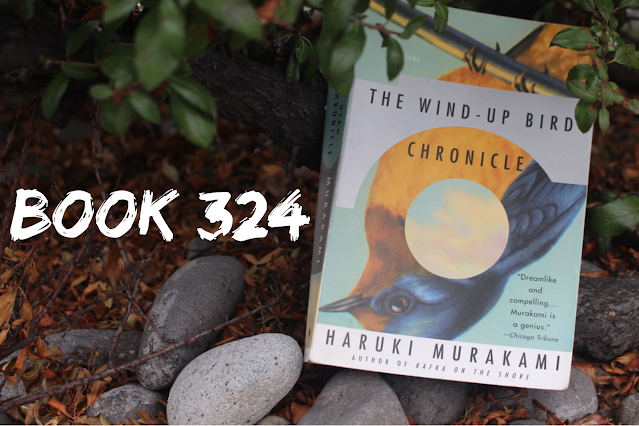
Book 324: The Wind-Up Bird Chronicle


"But even so, every now and then I would feel a violent stab of loneliness. The very water I drink, the very air I breathe, would feel like long, sharp needles. The pages of a book in my hands would take on the threatening metallic gleam of razor blades. I could hear the roots of loneliness creeping through me when the world was hushed at four o'clock in the morning." 

Dates read: June 27-July 5, 2019

Rating: 7/10

Lists/awards: 1001 Books You Must Read Before You Die

Sometimes I feel like living in the era of technology has robbed the world of its magic. Anyone with an internet connection can have access to what once were locals-only "secret" places. A rational explanation for something odd is almost always just a google away. You can have access to scads of information about almost anyone you meet in minutes. There's so little room left for actual mystery.

I remember reading somewhere that Haruki Murakami's books are among the most-stolen from bookstores. I'm not sure why that is, but there's no denying that the Japanese author has very devoted fans. Reading The Wind-Up Bird Chronicle was my first experience with him, and left me both sort of getting it and sort of not. It's a hard story to describe: there's a guy, Toru Okada, who lives outside of Tokyo with his wife, Kumiko, and their cat (which they've named Noboru Wataya, after her disliked brother) has gone missing. Toru has recently left his longtime job in a lawyer's office, but is unemployed while he tries to figure out what's next. Kumiko wants him to find the cat, and his searches for it lead him to strike up an acquaintance with a strange teenage girl, May, who lives down the block. That's when the phone calls start.

First, there's a woman who says she knows who he is and starts talking dirty to him. But then there's a psychic, a woman named Malta Kano, who explains that Kumiko has reached out to her to help with locating the cat. Kumiko and her family believe in things like psychics, having previously arranged for Kumiko and Toru to spend time with an old man called Mr. Honda, allegedly for spiritual consultations...but all that actually happens is that he repeatedly tells them about his experiences as a soldier in Manchuria during World War II. Toru meets with Malta Kano, and her sister, Cresta, but before long Kumiko herself disappears. She sends Toru a letter explaining that she's left him for a coworker with whom she's been having an affair, but he doesn't believe this and decides to try to find her, which brings him into contact with even more strange people, including a mother and son who he calls Nutmeg and Cinnamon. And appearing throughout is the sound of a bird, that sounds like something mechanical being wound.

This is a weird book, and I'm not sure I entirely understand it. It's one of those that you finish and almost want to flip right back to the beginning and start again, to see if it makes any more sense the second time through. I think there will be a second time through, though certainly not now. And there will definitely be more Murakami. If I had to chose a single word to describe it, it would be "dream-like". The way Murakami uses language and builds the world of the book create a feeling of constant loose connection, almost a structured free association, in which the concept that would tie everything together is just tantalizingly out of reach. It works well, and I found myself turning the pages and getting drawn further and further into it, though I suspected (correctly) that not everything was going to be tied up in a neat bow by the end.

Honestly, though, once I finished it, though I felt like I liked it, I have had a hard time articulating exactly why. It was obtuse, the female characters were largely underdeveloped (though I did love May), and it felt like some storylines were just dropped like hot potatoes. But despite its flaws, it's strangely compelling. There's something magical and mysterious about the world as Murakami creates it, and it did get me thinking about some of the deeper themes that were explored, like our obligations to each other as people and the nature of power in relationships. It's intellectually engaging despite the kind of haziness about it. If you're ready for something non-traditional, I would recommend this book.

One year ago, I was reading: Tooth and Claw

Two years ago, I was reading: Year of Wonders

Three years ago, I was reading: Delirium

Four years ago, I was reading: Boy, Snow, Bird

Five years ago, I was reading: Mrs. Dalloway

Six years ago, I was reading: Spinster

Thursday, August 19, 2021

Book 298: The Prime of Miss Jean Brodie


"She thought of Miss Brodie eight years ago sitting under the elm tree telling her first simple love story and wondered to what extent it was Miss Brodie who had developed complications throughout the years, and to what extent it was her own conception of Miss Brodie that had changed."

Dates read: February 24-27, 2019

Rating: 6/10

Lists/awards: Time's All-Time 100 Novels, 1001 Books You Must Read Before You Die (2012 edition)

Like everyone who's ever been to school, I've had teachers that run the gamut. Most of them were decent. Some were awful. Some were great. There was my fourth grade teacher, who was personally offended that I would read during class because I was bored and made it her mission to embarrass me by catching me not paying attention (she never succeeded). And then there was Mrs. Helppie, my AP English teacher who single-handedly taught me to write with anything approximating skill and would make us kettle corn and show us movies based on books/plays on Fridays. I will never forget her or her truly impressive selection of jewelry.

For most of us, our formative teachers are people whose influence on us was in the classroom, where their inspiration was related to learning about the world. In Muriel Spark's The Prime of Miss Jean Brodie, however, things are different. The titular Ms. Brodie cultivates a group of girls at their school in Scotland, seeming to be one of those "inspirational" teachers often idealized in books and film: she believes that what happens outside of the classroom can be just as important if not more so than what happens inside of it. She invites them (brainy Monica, pretty Jenny, sporty Eunice, sultry Rose, observant Sandy, and the poor scapegoat, Mary) to her home, takes them on cultural outings. But along with art and history, Ms. Brodie is also a big fan of fascism. And her interest goes beyond just being a role model for her girls...as they grow up, she begins to manipulate them.

Ms. Brodie is a single woman, and falls in love with Mr. Lloyd, the married art teacher. Their mutual affection is never consummated, so even while Ms. Brodie carries on a relationship with the bachelor singing teacher Mr. Lowther, she schemes to get one of her girls to have an affair with Mr. Lloyd in her stead, confiding in Sandy about her plans. While Rose is her intended proxy, it is Sandy who winds up sleeping with him, and who adopts his Catholic faith and becomes a nun. It is from the convent that she is recounting her youth and the role Ms. Brodie played in her life.

This is a brief work, only about 150 pages. As such, many of the characters are flat, even most of the "Brodie set" outside of Sandy. But generally speaking, it paints a vivid portrait of a time, and a place, and the people involved. Jean Brodie is a character who soars off the page, complex and interesting and so deeply flawed. For all her bluster and bravado and determination to avoid pity, she's ultimately a pitiful figure. And one who's careless of the damage she causes, inspiring a student to run away to fight for Franco, which leads to her death. On a lesser level, Sandy's assignation with her art teacher does not leave her without damage.

I was of two minds about the length. On the one hand, I wish there had been more time to develop the other girls, and the relationships between them as well their connection to Ms. Brodie. On the other hand, I don't know that the plot would have the same power, the same feeling of a drive toward the inevitable conclusion, if it had to persist over a longer period of time. This is a solid book, and an unusual twist on the stories about teachers who change lives. I'd recommend it for a quick, engaging read.

One year ago, I was reading: The Many Lives and Secret Sorrows of Josephine B

Two years ago, I was reading: The Forgotten Sister

Three years ago, I was reading: Life After Life

Four years ago, I was reading: Mildred Pierce

Five years ago, I was reading: Wild Bill Donovan

Thursday, March 4, 2021

Book 274: The Gathering


"I have all my regrets between pouring the wine and reaching for the glass."


Dates read: November 7-11, 2018

Rating: 5/10

Lists/awards: Booker Prize, 1001 Books You Must Read Before You Die (2012 edition)

It's weird what I do and don't remember from my childhood. There are moments that stand out in my mind clearly, the feeling of swinging on the swingset at home and launching myself into the air, of jumping on the trampoline, of the stinging black flies on the shores of Lake Superior. And then there are things that I know happened but I couldn't provide a clear recollection of if you paid me. And then there are some in-between, neither clearly recalled nor completely blank, that almost feel like memories out of dreams. Did they actually happen? Was I just told about them so many times I feel like the memory is my own now? Or did I just make them up playing pretend and they stuck?

Human memory is deeply fallible. Being a psychology major who went to law school, I was and continue to be horrified at the credibility of eyewitness testimony. We think of memories as files in a cabinet or videos that can be played on demand, but in actuality they're as malleable as clay. The unreliability of memory is key to Anne Enright's The Gathering. In it, Veronica Hegarty is reuniting with her large family in Ireland for the funeral of one of her many siblings...Liam, with whom Veronica was particularly close. She meditates on her current unhappiness while also trying to figure out her brother's, who died from alcoholism, and to what extent the way their lives have turned out is rooted in a hazy memory from their childhood.

To explain what might have happened, Veronica spins stories about her grandparents. She does not know to what extent any of them might be true, but she's desperate to explain the complex bonds between them that might shed light on what occurred later, when she and Liam were living with them. In the meantime, her own marriage is struggling to survive, and going back home and dealing with all of her relatives again further stresses her. It's a portrait of a woman at a loss, trapped in her own ruminations, needing a path forward but (to borrow a line) borne back ceaselessly into the past.

Anyone who's wondered if we can ever really escape from ourselves and our pasts will appreciate Enright's work here. Her language is lush and evocative, and Veronica's struggle to understand her family history and her own life is rendered powerfully. That feeling of childhood memory, the way the details get harder to recall the more we try, and the challenge of trying to extract meaning from it is also captured poignantly. Veronica's heartache feels real, wanting neither to fall into the easy trap of blaming everything on family but unable to figure out how much blame to assign where.

While I appreciated aspects of Enright's craft, I did not like this book. It's often confusing to read, moving back and forth in time without clarity. When we're introduced to Veronica's imaginings about her grandparents' early lives, it's not clear until later on that these are rooted in nothing more than her own imagination. And while I'm no prude, I have never read a book so fixated on describing erections in my life and hope I never do again. While it kind of made sense, based on what's revealed over time, it was awkward and honestly unnecessary. It took me out of the book entirely. And although it's less than 300 pages long, the book honestly feels like it's been puffed out and was in real need of editing. Usually the Booker is a good list for me in terms of books I'm likely to enjoy reading, but this one just did nothing at all for me. I do not recommend it.

One year ago, I was reading: We Are Our Brains

Two years ago, I was reading: Going Clear

Three years ago, I was reading: Good Omens

Four years ago, I was reading: Die A Little

Five years ago, I was reading: The Good Earth

Thursday, December 17, 2020

Book 264: The Things They Carried


"I remember Norman Bowker and Henry Dobbins playing checkers every evening before dark. It was a ritual for them. They would dig a foxhole and get the board out and play long, silent games as the sky went from pink to purple. The rest of us would sometimes stop by to watch. There was something restful about it, something orderly and reassuring. There were red checkers and black checkers. The playing field was laid out in a strict grid, no tunnels or mountains or jungles. You knew where you stood. You knew the score. The pieces were out on the board, the enemy was visible, you could watch the tactics unfolding into larger strategies. There was a winner and a loser. There were rules."

Dates read: September 27- October 1, 2018

Rating: 9/10

Lists/awards: 1001 Books You Must Read Before You Die (2012)

It seems like, when it comes to books about wars, World War II is the popular one. Fiction or nonfiction, there's no lack of written material about it. World War I also has plenty of reading to discover. There's a distance from these wars, and they have a moral clarity that's appealing. There are good guys and bad guys and it's not hard to tell who's who. But the more recent wars: Korea, Vietnam, the Gulf, Iraq...they don't seem to have attracted the same kind of literary attention.

Which doesn't mean this kind of literature doesn't exist, though. When it comes to Vietnam, Tim O'Brien's The Things They Carried is the standard-bearer. A collection of interlinked short stories, it explores a platoon of soldiers before, during, and after their service in Vietnam. It's told through the perspective of a young solider, also named Tim O'Brien, who is not only a writer but specifically writing these stories, and as the book is rooted in author Tim O'Brien's own experiences with the war, it's all very meta, even including a short story about figuring out how to tell a war story. Though O'Brien's character is the most central one, he explores several other perspectives besides his own.

The central plot, such as there is one (which is loose at best and completely out of chronological order), tells the story of Tim O'Brien the character. When drafted to fight, he's afraid, and very nearly crosses the Canadian border to escape. Ultimately, though, he returns home and then is shipped off to Vietnam, where he joins a platoon, gets to know his fellow soldiers, and watches them kill and be killed. He is wounded a few times, the second of which is serious enough that he's removed from the fighting and taken to the hospital, and shortly thereafter goes back to the US. After the war, he and his fellow veterans struggle to make sense of their experiences. While Tim finds some level of solace in becoming a writer, others can't make the readjustment.

As in any collection of short stories, some are particularly strong and others are weaker. The title story, the first in the book, detailing the baggage both physical and emotional that the soldiers carry with them through the jungle, is the standout. I'm not much of a short story person, but this one is about as close to perfect as any I've ever read. The language, the characterization, the pacing, all of it is amazing. It's the perfect way to start things off. "On The Rainy River", which details Tim's flight to the Canadian border and near-crossing of it, is also beautiful and poignant. And "Speaking Of Courage", about one of Tim's platoon-mates who can't seem to figure out how to fit into the world again after the war, is absolutely heartbreaking. On the weirder side, "Sweetheart of Song Tra Bong", about an urban legends shared among the soldiers of a girlfriend who came over to visit and became more and more immersed in martial culture until she disappeared into the wild like a ghost, never to return, has compelling echoes of Heart of Darkness.

I will say that some of the more meta aspects of the book didn't quite work for me, like the "How to Tell a True War Story" piece that I mentioned earlier, as well as "Good Form", a story that reveals a previous story to have been told in a way that is factually incorrect but emotionally true. Though ultimately it didn't take away from the writing or its impact on me, I did wish the book was either straight fiction or straight nonfiction. That's a minor quibble, though. On the whole I thought this book was very well-executed and incredibly affecting. It gave me perspective into and empathy with the lives of those who have lived through something I never will, which honestly is one of the biggest points of reading for me. I would highly recommend this book for all readers.

One year ago, I was reading: House of Cards

Two years ago, I was reading: The Prince of Tides

Three years ago, I was reading: The Lady of the Rivers

Four years ago, I was reading: The Red Queen

Five years ago, I was reading: Occidental Mythology

Thursday, August 13, 2020

Book 246: Disgrace


"A risk to own anything: a car, a pair of shoes, a packet of cigarettes. Not enough to go around, not enough cars, shoes, cigarettes. Too many people, too few things. What there is must go into circulation, so that everyone can have a chance to be happy for a day. That is the theory; hold to the theory and the comforts of theory. Not human evil, just a vast circulatory system, to whose workings pity and terror are irrelevant. That is how one must see life in this country: in its schematic aspect. Otherwise one could go mad. Cars, shoes; women too. There must be some niche in the system for women and what happens to them."

Dates read: July 2-5, 2018

Rating: 8/10

Lists/Awards: Booker Prize, 1001 Books You Must Read Before You Die (2012)

Once upon a time, it seemed, there was a kind of script for powerful men who got caught behaving badly around women. There would be a statement full of vague, none-too-sincere seeming apologies for their actions and crocodile tears. There would be a trip to rehab, usually for "sex addiction" but sometimes for substances if they'd blamed that for their misdeeds. There would be an announcement of some sort of charitable contribution, often money but sometimes actual volunteer work if they wanted to really put on a show. They'd go away for a while, 6 months or a year. Then there would be a sit-down interview on a broadcast network where they talked about how much they'd changed and how they couldn't even recognize the person they used to be. The interviewer would lob softball questions designed to elicit sympathy. Then back to business as usual.

Then came Harvey Weinstein and #MeToo. You could see Harvey trying to trot out the old familiar playbook, disappearing to sex rehab. But it didn't work. The failure of the established pattern is also at issue in J.M. Coetzee's Booker Prize-winning Disgrace, except in this case it's because the man in question specifically refuses to use it. David Lurie is a white professor at a university in Cape Town in post-apartheid South Africa. A frustrated scholar of the Romantic literary tradition, interest in his classes has dwindled and he finds himself teaching Communications. He's an unhappy man, twice divorced and mostly uninterested in developing actual relationships with other people. On a whim, he decides to pursue a beautiful student in one of his classes. They sleep together a few times, all at David's initiation and at least once when he's aware that she doesn't actually want to. Suddenly her boyfriend shows up in class, and shortly thereafter he finds himself accused of misconduct against her.

He's offered the standard-issue response: an apology, counseling, a break, but an eventual return assured. He refuses, simply capitulating, and leaves Cape Town for the countryside, where his daughter Lucy owns and runs a small farm. No sooner does he get somewhat accustomed to life there, though, than an episode of violence changes things forever. Three young black men attack David and Lucy, attempting to burn him and gang-raping her. The already-strained relationship between father and daughter becomes even more tense as both try to cope with their trauma in different ways.

It's obvious fairly early on that the characters and situations aren't intended to be always read as strictly realistic. There's a lot of allegory going on here about apartheid and the wounds that it left and the violence that was a crucial part of that system continuing to resonate. I found myself wishing I had more background in the history of South Africa, because I felt like there were layers and layers of meaning and some of them were out of my grasp. Disgrace is a fairly short book, not even 250 pages, but there is a lot going on in it because Coetzee is an absolutely master of his craft. Every word of this book was obviously carefully, deliberately chosen and he evokes so much by just letting his plot and characters speak for themselves. And speaking of characters, such a sticking point for me as a reader, this was a strange experience in that I didn't find anyone especially compelling but still found the book as a whole to be something that I was invested in.

So what I'm saying is that this is a very good book, but reader be warned: it is bleak. It is a story about a terrible person, who does some awful things. You almost wonder if he deserves it on some level, but even worse things happen to his daughter and she's just trying to live on her little piece of land and doesn't seem at first blush to be culpable. Or is she? Are all of those who benefit from systemic inequality culpable? There is a note of hope at the end with the promise of the birth of a biracial child, clearly meant to be symbolic of the way forward, but honestly using a child who will also be the offspring of a violent rape of a lesbian woman to represent that hope is extremely cynical. This is a high quality book that I appreciated the experience of reading and am glad I read and have no plans to ever return to because it was hard. I would definitely recommend it, but go in expecting a downer (and be aware that there's violence toward animals/animal death in case you're sensitive to it).

One year ago, I was reading: Bright Boulevard, Bold Dreams

Two years ago, I was reading: The Informant

Three years ago, I was reading: Charity Girl

Four years ago, I was reading: A Passage to India

Thursday, July 9, 2020

Book 241: Love Medicine


"You see, I thought love got easier over the years so it didn't hurt so bad when it hurt, or feel so good when it felt good. I thought it smoothed out and old people hardly noticed it. I thought it curled up and died, I guess. Now I saw it rear up like a whip and lash."

Dates read: June 12-16, 2018

Rating: 7/10

Lists/awards: American Book Award, 1001 Books You Must Read Before You Die

I've lived in Nevada since the summer of 2012. It'll officially be eight years at the end of this month! This is where I've spent more of my adult life than any single other place, and where (assuming nothing major changes) I'll spend the rest of it. But if you ask me where "home" is, I'd still tell you it was Pinckney. My relationship with the place I grew up is complicated, and I am not upset that it's not where I've ended up, but there's just something that it has marked on me indelibly, in a way that no place else has ever really been able to replace it in my mind as my home.

The instinct to turn towards home, to seek refuge there in times of strife, kicks off Louise Erdrich's Love Medicine. June Morrissey, drunk and struggling in Williston, North Dakota, decides to head back to the reservation when she was born and raised. The problem is that she doesn't have proper winter clothes and there's an enormous blizzard. She dies on her journey, and the book moves both forward and backward in time to tell the story of June, her quasi-adoptive parents Nestor and Marie Kashpaw, Nestor's childhood sweetheart Lulu Lamartine, June's children and cousins and nieces and nephews and a whole sprawling cast of others. It's classified as a novel, but honestly is much more a collection of short stories about a common set of characters. The placement of the stories is obviously deliberate, revealing information about the subjects bit by bit, but the book as a whole doesn't really have a defined narrative arc.

I think, for a lot of people who grew up far from reservations and didn't really know many (or any) Native Americans, it can easy to think about them as almost preserved in amber...our idea of what "an Indian" looks like and what their experiences are is rooted in black and white photos and/or stereotypes. Even though some might think it's less damaging because of its romantic (in the larger sense of the word), it's still a prejudiced and honestly racist way of thinking. Native Americans still exist. They live in the world. They talk on cell phones. But they remain mysterious to many other Americans, which is why this book isn't just good, it's also important, in that it presents a realistic portrait of Indian life on a reservation, showing it to be full of people: some better, some worse, some smart, some dumb, some kind, some harsh. It has its own challenges and experiences just like any other community, but it's made up of the same kinds of humans we find everywhere.

As might be expected for a book with the word "love" in the title, the bonds we form with others, both those rooted in blood and those created by the body and the heart, is the central through-line connecting the pieces of the story together. Though no one's story is presented in a straightforward, neatly chronological way, Erdrich creates vibrant characters who resonate with emotional truth over the course of the narrative. She gives us little snapshots of their lives at points in time, pieces that begin to cohere into a whole. That this book spawned multiple sequels doesn't surprise me at all: the people she creates clearly have long histories that bear further exploration.

This is a book that strongly favors characters over plot. While all of the individual stories have their own little dramas, there's not a lot of narrative flow over the course of the book. The real interest is in seeing the characters over the course of their lives, meeting a woman when she's a grandmother and then getting a look at the young woman she was before the rest of her life happened, figuring out how she might get from there to here, getting little glimpses along the way. Erdrich's writing is beautiful: it tends towards the lush without veering into purple prose territory. I will say, though, that effectively as she does wield her chosen episodic format, the lack of tension or drive to the book was a bit of quibble for me and it was hard to get "sucked in" because of it. Even so, this is a very good book and I would recommend it widely. It might not quite be your cup of tea in the end, but it's very much worth reading.

One year ago, I was reading: Polite Society (review to come)

Two years ago, I was reading: The Looming Tower

Three years ago, I was reading: The Amazing Adventures of Kavalier and Clay

Four years ago, I was reading: Under the Tuscan Sun

Thursday, May 14, 2020

Book 233: Far From The Madding Crowd


"She was the stuff of which great men's mothers are made. She was indispensable to high generation, hated at tea parties, feared in shops, and loved at crises."

Dates read: May 11-16, 2018

Rating: 8/10

Lists/awards: 1001 Books You Must Read Before You Die (2012 edition)

Most people will say that they appreciate a "strong female character", but what exactly do we mean by that? What makes a woman strong? Often it seems like it gets interpreted as literal physical strength, a la Buffy Summers, or else a kind of "tough girls don't cry" emotional repression. As a reaction to the stereotypical depiction of women as delicate flowers prone to wailing or running away when faced with challenges, or as objects to be rescued and therefore earned at the end, there is strength in presenting women as having physical and/or emotional toughness. The idea, though, that the way for women to be strong is to be more like men doesn't feel like it encompasses enough about women's strength.

As a woman, I think what I most gravitate towards when I'm looking for a "strong female character" is agency. The ability to make her own choices, knowing the consequences, and then continue to make them for better or worse in a way that feels like they're actually real choices a person would make. There are a surprising number of these kinds of characters in the classics (though they have a not-unfair reputation for being dominated by men's stories), and some of my favorite have been found in the work of Thomas Hardy. In his Far From The Madding Crowd, our central character is Bathsheba Everdene, who we watch grow from an inexperienced but capable young woman to owning and running her own farm and learning some brutally hard lessons about relationships, through her own effort and largely by her own hand. Bathsheba isn't without flaws, and some of the choices she makes are bad ones, but you never lose the sense that she's in control of her own destiny.

Bathsheba catches the eye of young farmer Gabriel Oak when she's on her way to live with a cousin to help out on the farm, and he soon grows besotted with her beauty. He proposes, but through they've built a friendly acquaintance, she shoots him down because she doesn't love him. She leaves when she inherits a farm of her own, and after financial disaster strikes and Gabriel loses his own toehold in the landed class, he winds up working for her as a shepherd. Unlike many owners (particularly female ones), she insists on being an active part of the operation of her land, and she and Gabriel become trusted allies to each other. When a silly joke with an older, eligible bachelor neighbor, Boldwood, leads to the other man's obsession with her, Bathsheba resists making a marriage with him as well but is under tremendous pressure to accept his suit. And then Sergeant Troy happens...he's young and hot and even though his heart belongs to his childhood sweetheart, he and Bathsheba have a whirlwind fling that ends in holy matrimony. Drama ensues.

If you can read Hardy without feeling a passionate longing to go spend some time out in the middle of nowhere for a while, you're a stronger person than I am. He doesn't gloss over the very real toil of rural life, but he presents it so persuasively as the most harmonious way to live that it makes you think about what it would be like to chuck it all and go buy a little piece of land and work it yourself. I would never do that, I know I'd hate it about 48 hours in, but Hardy was very concerned with growing industrialization and his preference to maintain traditional pastoral lifestyles is obvious. But his real strength lies in his complicated, multifaceted characters. While Gabriel Oak is a little on the idealized side, Bethsheba, Boldwood, and Troy are all painted in shades of grey that give them nuance and interest, and the drama derives from circumstances that mostly feel organic, giving real weight to their choices and interactions.

The more classics I've read in my late 20s and beyond, the more convinced I am that we do young readers a disservice by insisting on reading them in high school. While there's nothing going on here at a conceptual level that a reasonably intelligent teenager couldn't grasp, there's also so much more that you can bring into the novel of your own experience once you have some under your belt that gives it so much more life. If I'd tried to read this at 16, I doubt I would have cared for it, but at 32 (which is how old I was when I read it) it's got full layers of meaning that I really responded to. It's lengthy, but it moves along pretty well, and I would definitely recommend giving it a read!

One year ago, I was reading: The Brief Wondrous Life of Oscar Wao

Two years ago, I was reading: This!

Three years ago, I was reading: The Skies Belong to Us

Four years ago, I was reading: We Need to Talk About Kevin

Thursday, February 13, 2020

Book 220: Freedom


"This wasn't the person he'd thought he was, or would have chosen to be if he'd been free to chose, but there was something comforting and liberating about being an actual definite someone, rather than a collection of contradictory potential someones."

Dates read: March 30- April 3, 2018

Rating: 8/10

Lists/awards: 1001 Books You Must Read Before You Die (2012 edition), The New York Times bestseller

Something that seems to come up fairly frequently in profiles of successful people is that they have a daily uniform. Like Steve Jobs' constant black turtleneck and jeans, many of them report that not having to think about what they're going to wear every day frees up their minds for "more important" things. It's a concept called decision fatigue...the more decisions you have to make, the worse (over time) you get at making them logically. For me, deciding what to wear is enjoyable, but I do eat almost the exact same thing every day because food isn't that interesting to me. Cutting unnecessary choices out of your life does make things a lot simpler.

Jonathan Franzen's Freedom isn't very subtle: he tells you the major theme of the book right there in the title. It's the story of a family, headed by Walter and Patty Berglund, and how it comes to be and how (of course) it begins to fray. It begins with a short, third-party history of their residence in a newly-gentrifying neighborhood in Saint Paul, which begins when they're young, energetic newlyweds, and continues through their raising of two children, Jennifer and Joey, the latter of whom causes quite a bit of grapevine drama when he takes sides against his own family in a growing border war with their neighbors. Just about as soon as the kids are out of high school and off to college, the parental Berglunds pick up and leave suddenly, and several years later in the newspaper their former neighbors read that Walter's gotten into a bit of a professional dust-up. So right from the beginning, we know that something is rotten in the state of Minnesota.

We then go back and time and get Patty's life story, in which she always feels like an outsider in her ambitious upstate New York family, culminating in her parents' refusal to do anything when she's raped by the son of a powerful neighbor. She flees on an athletic scholarship to Minnesota, where she develops a friendship with a disturbed classmate, through whom she meets musician Richard Katz and his roommate, Walter Berglund. Though Richard and Patty are interested in each other, Walter is also interested in Patty, and though he "gets" the girl, the attraction between his wife and his best friend lingers. We also move forward to Richard, Walter, and Joey's perspectives after their move out of Minnesota, and how each struggles with freedom as opposed to stablility, and the consequences of exercising choices that become available.

Jonathan Franzen as a human being is not my favorite. But as a writer, he is undeniably talented. Freedom wrestles with some weighty stuff: 9/11, environmentalism, corporate philanthropy, temptation, infidelity, the way family patterns repeat over generations, sexual assault, selling out, forgiveness. That's a lot for one book, even a long-ish one, to tackle. But for the most part, he pulls it off. Though I didn't necessarily always like the characters he created, I almost always found them compelling and interesting. Though some of the plot schemes he tangles them up veer towards the ridiculous, he mines them for emotional truth well enough that they stay on the good side of the line of believability.

There are some missteps, though. I found some of his decisions regarding Patty's trajectory baffling. Her rape doesn't seem like a character-informing experience for her, serving rather as an explanation to write her parents out of the book until there can be a rapprochement at the end to bring things full circle. And her college friend Eliza's obsession with her also seemed underbaked...it never really went anywhere besides serving as her introduction to Richard. The balance of Patty's story rounded her out, but the way he wrote Connie (Joey's childhood sweetheart) never made sense to me. She's not a person, she's a symbol, as was Lalitha, a young colleague of Walter's who becomes besotted with him. Maybe our cultural moment just has me primed to see underlying misogyny better than I used to, but I can't deny that it's here and it was part of what kept me from being fully absorbed in the novel. It's good, very good even, and I would recommend it with the caveat that if you're looking for strong female characters, you won't find them here.

One year ago, I was reading: Forest Dark

Two years ago, I was reading: Wonder Boys

Three years ago, I was reading: Zealot

Four years ago, I was reading: Ahab's Wife

Thursday, February 6, 2020

Book 219: Of Human Bondage


"He yearned above all things for experience and felt himself ridiculous because at his age he had not enjoyed that which all fiction taught him was the most important thing in life; but he had the unfortunate gift of seeing things as they were, and the reality which was offered him differed too terribly from the ideal of his dreams." 

Dates read: March 25-30, 2018

Rating: 7/10

Lists/awards: 1001 Books You Must Read Before You Die (2012 edition)

Sometimes I think about my younger self and I want to shake that girl by the shoulders. I took myself so seriously, took the world so seriously. I was so sure of things, and while I do sometimes miss that clarity of certainty, I think I'm happier now. I tend towards the "control freak" side of things, and the more steps I take towards letting go of that need to be in charge of everything, to know where it's all heading, the more relief I feel and the better able I am to roll with the punches. I wish I could tell that girl that I was how to loosen up a little bit, how to think a little more broadly...but maybe all that can really teach those lessons is time.

Anyone who's ever taken themselves too seriously will recognize a kindred soul in Philip Carey of W. Somerset Maughum's Of Human Bondage. We meet him when he's still a child and very recently orphaned, going from a relatively privileged life with his mother to a much sparser one with his aunt and uncle, the latter of whom is a pastor in a small town in the British countryside. Scared a bit by his distant uncle, he escapes into books and becomes a voracious reader. The next year, he's sent to boarding school, where his disability (he has a clubfoot, which gives him a limp), combined with his shyness and senstitivity, makes for a generally unhappy experience. He becomes passionately religious and plans on a career in the clergy, but when his prayers for a cure for his foot are unanswered, he loses both his faith and his direction in life.

He goes to Germany briefly, comes back to England and tries being an accountant, which doesn't take, then to France to study art, then back to England again, where he decides to settle down and study medicine, which was his father's career. But all his indecision has driven down his available resources so he'll need to live very modestly until he's a doctor and can start earning a living...and then he meets Mildred. Despite Philip's self-pity, he's had a few relationships with women at this point, and is actually in a good one, when he meets the waitress his friend has a crush on. Philip becomes obsessed with her, despite her obvious disinterest in him and lack of social skills. His situation eventually becomes desperate, but with some kindness and a bit of luck, it resolves itself.

If you've been reading here for a while, you know I'm a die-hard never-DNF (did not finish). This has lead to my spending my time reading books that I hated or worse, bored me silly, and I very much understand why other people do put down books that aren't working for them. But even though it does backfire on me sometimes, other times it pays off to stick with a book, and this was one of those instances. About halfway through it, I was sick of Philip and his moping and the garbage way he treated women and his refusal to understand that as wonderful as self-discovery is, there's no money in it. The whole book is his story of growing up, and he was so grating that I wasn't at all invested in him or rooting for him to succeed. But then he starts to mature, puts his head down and works hard, uses his own hard-earned life lessons and experiences to be a good doctor to the people he sees. And by the end of it, when he does find some measure of happiness and chooses to do the harder, better thing, I couldn't have been happier for him if he were an actual person and a friend at that.

I've always been a character-over-plot type of reader, and this book is all the former...the only major outside event is the Boer War, which happens late in the book and while it does have an impact on Philip, it's pretty far removed from the central themes of the coming-of-age story. In some ways, it suffers for its fixation on Philip...like I said above, he can be a hard character to really sympathize with, particularly early on. But the payoff in the back half is real, and seeing him grow as a person is really rewarding. This is a good book, a very good one even, but it may not be the right book for every reader. If you're looking for a dynamic plot, or lack the patience for/interest in a long-term character study, this probably isn't going to be something you enjoy. If you've read what I've written and are intrigued, though, I highly suggest you get ahold of it...it'll be a rewarding experience!

One year ago, I was reading: The Buried Giant

Two years ago, I was reading: The Sellout

Three years ago, I was reading: Flowertown

Four years ago, I was reading: Creative Mythology

Thursday, September 12, 2019

Book 198: Rebecca


"Unconsciously I shivered, as though someone had opened the door behind me, and let a draught into the room. I was sitting in Rebecca’s chair, I was leaning against Rebecca’s cushion, and the dog had come to me and laid his head upon my knee because that had been his custom, and he remembered, in the past, she had given sugar to him there."

Dates read: December 24-29, 2017

Rating: 8/10

Lists/awards: 1001 Books You Must Read Before You Die (2012)

We've all felt like an imposter at some point, right? Like, I don't think "imposter syndrome" is even a thing, I think it's so commonplace as to be just a part of the human experience. It's an ugly, scary feeling, to be so full of doubt about yourself. It feels especially endemic in that late teens-early 20s time of life, when everyone even five years older seems impossibly glamorous and adult and you still feel like a kid. You just were a kid, after all, and now you're expected to set your own alarm and remember to take your vitamins and schedule your own haircuts. "Adult" feels so far away even though you're already there.

I've never read a book that feels as steeped in that feeling of being an imposter as Daphne DuMarier's Rebecca. Our heroine is a never-named middle-class young English woman, in her early 20s, who's earning her living as a traveling companion to an crude older woman. On a stop in Monaco, she meets Maxim deWinter, who her employer is all too happy to repeat gossip about and try to kiss up to: he's the owner of the famous and magnificent country estate of Manderly, and his beautiful, stylish wife Rebecca recently died tragically. The young lady and Maxim have a whirlwind courtship, and before she knows it, she's married and honeymooned and off to her new home and new life as the mistress of a great house.

But when they get to Manderly, things go quickly south. Being middle-class, she's barely been in a place like this, and hasn't the slightest idea how to make it her own. Her husband is suddenly distant and moody. Her only real friend is the spaniel dog that she takes her walks with. The head housekeeper, Mrs. Danvers, all but openly sneers at her and constantly reminds her that she's not anything like the charming and passionate Rebecca. And it's not just Mrs. Danvers...even the locals she goes to visit tell her over and over again how exciting things were when Rebecca was around, how beautiful she was, how delightful. The shy, quiet second Mrs. deWinter begins to despair of ever being good enough for the role she's been handed, and is talked into putting on a costume ball (like the ones Rebecca used to have!) that changes everything.

If you've ever heard about super fast marriages Back In The Day and wondered if people even really knew each other when they go married, Rebecca answers that question with a resounding no. A major part of the drama comes from the fact that the young wife can't understand why Maxim married her and is afraid to share her fears and feelings of inadequacy because, well, she barely knows him. She tortures herself by imagining that he's constantly comparing her to Rebecca, and she's sure she comes up short. She can't even hide from the imposter syndrome that's consuming her...the very place she lives reminds her of the ways in which she feels inadequate. This book is often billed as a gothic romance, and while the former is accurate, the latter isn't really, in my opinion: there's a marriage at the center of it, but not really a romance per se.

Instead, I'd call this a psychological suspense novel. We know from the beginning that the deWinters no longer live at Manderly, that something bad happened there. How exactly this happens unwinds over the course of the book, with the inner lives of the characters and their relationships with each other being driving the action. And the story is well-told and well-paced, but it's still a classic rather than a modern-day thriller, so while it's certainly gripping it's not really a page-turner that'll keep you up all night. And for me, that's preferable anyways. I really enjoyed reading it and plan to add more duMaurier to my list of books to read. I'd recommend Rebecca to just about anybody, it's a tightly crafted and engaging story that'll appeal to anyone who's ever felt like they were playacting at being a grown-up.

One year ago, I was reading: The Silence of the Girls (review to come)

Two years ago, I was reading: Valley of the Dolls

Three years ago, I was reading: Smoke

Thursday, July 18, 2019

Book 190: The House of Mirth


"She had been bored all the afternoon by Percy Gryce—the mere thought seemed to waken an echo of his droning voice—but she could not ignore him on the morrow, she must follow up her success, must submit to more boredom, must be ready with fresh compliances and adaptabilities, and all on the bare chance that he might ultimately decide to do her the honor of boring her for life."

Dates read: November 17-22, 2017

Rating: 7/10

Lists/awards: 1001 Books You Must Read Before You Die (2012)

This is going to sound stuck up, but I've been told I'm pretty since I was a little girl. Now that I'm an adult, I don't think I'm devastatingly good-looking, but I'm generally pretty secure that I'm more attractive than not. It's interesting, the way women are trained to think that our looks are one of the most important things about us, but then we're supposed to wait for men to notice and acknowledge it, and we're ridiculed for the things we do to maintain it in the face of time and aging. My husband worries about putting on moisturizer because his skin feels dry and gets flaky in the winter. I worry about putting on all of the steps in my Asian skincare routine so that I combat wrinkles. Don't get me wrong, I love my k-beauty. But I'm aware that social pressure plays a disproportionate role in how I engage with my face, my skin, my body...not just for my own comfort, but for everyone else's too.

And that's in today's world! The farther back you go, the more a woman's looks were central to her prospects in life. When we meet Lily Bart, the heroine of Edith Wharton's The House of Mirth, she's 29 and worried that her celebrated loveliness is beginning to fade before she's managed to marry herself off to someone who can support her. Lily was raised in wealth, taught to abhor anything "dingy"...and then her father lost their fortune and died and her mother followed him shortly thereafter, leaving Lily poor and alone. She was begrudgingly picked up by her aunt Julia, who gives her the right address and some pocket money, but not nearly enough to keep herself afloat on the glittering social circuit, where she needs this season's stylish hats and gloves and dresses and is expected to gamble regularly at cards. It seems hopeful, though: she's on her way to her friend Judy's house, where she expects to meet and charm  and become engaged to Percy, a very eligible bachelor.

Instead, she feels no chemistry with Percy and earns the ire of married socialite Bertha when Bertha's ex-paramour Lawrence Selden turns up to see Lily. Bertha splits up the budding romance between Lily and Percy, leaving Lily in a position to have to ask Judy's husband, Gus, to make some investments for her to help keep her afloat. Gus views this as an investment in earning Lily's...favors, and though she manages to keep her head above water and even rise briefly, it all comes crashing down when Bertha invites Lily on a trip to keep her husband George distracted while Bertha carries on with her latest conquest. When George discovers the truth, though, Bertha spreads lies painting Lily as a temptress instead, which begins Lily's descent through the social classes.

This book plays with the same kind of themes Wharton would return to in her Pulitzer Prize-winning The Age of Innocence, which I read a few years before I read this: the artificiality of the upper-class New York "society" in which Wharton herself was born and raised and the way it constrains and even punishes real feeling primary among them. Lily herself is a great heroine: it's so easy to identify with her simultaneous longing to do the "right" thing and make it easy on herself by just finding someone rich to marry her and keep her in comfort and to be true to herself and wait for the kind of real connection she feels with Lawrence. Even though women are by and large much less dependent on men for material support today, I think there still exists the temptation, especially as one approaches 30, to just settle for someone good enough and check "marriage" off the list of things you constantly get asked about as a woman. And the power of the rumor mill, and its ability to ruin reputations, remains potent.

It's thematically similar enough to The Age of Innocence that comparison is inevitable, and for my money, Innocence is the better-developed and more rewarding work. But Mirth was also written 15 years beforehand, so it's not surprising that it's less mature. It does bring the added context of a female perspective, and it's partly refreshing to see how far we've come and at the same time how many things are still largely the same in terms of the constraints that society as a whole places on women. I will say one of the things that didn't quite work for me was the novel's central romance: it's never really developed, we're just meant to sort of assume that they've fallen for each other. It's necessary to have established for a late character moment to work, but it's done so superfluously that it doesn't quite have the power it could have. All in all, if you like a sharp social critique and old-society novels, or just like Wharton, it's definitely worth reading. Otherwise, pick up The Age of Innocence instead.   

One year ago, I was reading: Olive Kitteridge

Two years ago, I was reading: Valley of the Moon

Three years ago, I was reading: The Last Picture Show

Thursday, February 14, 2019

Book 168: The Sense Of An Ending


"We live with such easy assumptions, don't we? For instance, that memory equals events plus time. But it's all much odder than this. Who was it that said that memory is what we thought we'd forgotten? And it ought to be obvious to us that time doesn't act as a fixative, rather as a solvent. But it's not convenient—it's not useful—to believe this; it doesn't help us get on with our lives; so we ignore it."

Dates read: August 10-13, 2017

Rating: 8/10

Lists/Awards: Booker Prize, 1001 Books You Must Read Before You Die, The New York Times bestseller

Like many siblings, my sister and I squabbled a lot growing up. One time, and I can't remember what she said or did that prompted it (if anything), but I was mad at her and I told her that her teeth were yellow. It wasn't even true, they were pretty much the same color as mine. Years later, I asked her why she usually smiled with her mouth closed in pictures, and she told me that she'd been self-conscious about the way her teeth looked ever since I said that to her. I apologized and told her I was just being a jerk, of course, but I've made an effort since she told me that to really think before I snap back at someone I'm upset with. You never know how the words you toss off without thinking can really impact someone's life.

Julian Barnes' The Sense of an Ending illustrates the same principle on a much more profound scale. The book tells the story of Tony Webster, a deeply ordinary person. He went to school, worked a normal office job, got married, had a kid, got divorced, and remained on good terms with his ex into their retirement years. But a mysterious bequest drags him back towards most tumultuous time of his life. As schoolboys, Tony and his friends absorbed into their ranks the new kid in town, Adrian. Adrian was different than them: smarter, more serious. The group starts to fracture after graduation, everyone going their own separate ways to different schools or workplaces. At university, Tony meets and starts dating Veronica.

It is this ultimately short-lived relationship that changes lives. Veronica is mysterious and aloof, and Tony has a hard time knowing where he stands with her. They get serious enough that she takes him home to meet her family, but the only one that's nice to him once he gets there is her mother. They break up shortly after that trip, and not a particularly long time later Adrian writes to Tony to tell him that he's started dating Veronica. Tony is hurt, and writes back angrily. Then he goes on an extended jaunt to America, and it's not until he gets back to England that he hears that Adrian has committed suicide. Tony is, of course, upset, but his life goes on fairly smoothly until that bequest arrives: Veronica's mother has passed and left him a small sum of money and Adrian's diary. The money gets to Tony, but the diary is with Veronica.

Tony's journey to try to understand why he was left anything at all and attempts to get the diary comprise the balance of this slim novel. In its less-than-200 pages, it explores powerful themes: the difference between what we chose to remember and the truth, the impossibility of taking back something that's been said, how we change even though we feel like the same person we've always been. Barnes is a talented writer, and reflects on these with clear, emotionally resonant language that puts into words things that we (or at least I) have thought about but never really been able to distill. The mystery behind it all keeps the plot moving forward, but it never feels tantalizing just to inspire page-turning. Rather, the interesting thing is how Tony reacts to each new twist.

Barnes does brilliant characterization work with Tony, by the time things are wrapping up he feels like an old friend who has a way of dropping wistful bon mots about life. Both Adrian himself and Margaret (Tony's ex-wife) likewise feel realized despite appearing relatively infrequently in the narrative. But Veronica, who winds up being a significant factor, never really came together for me. The "clues" she gives Tony are maddening...if she really doesn't want to engage with him, she could have avoided him entirely, but for her to make just enough contact with him to drop cryptic references doesn't make sense. Either tell him what's going on, because he clearly doesn't get it, or ignore him. Her remoteness and Tony's inability to comprehend her are one thing, but I can't understand her own motives at all, which took away from my enjoyment of the book. As for the final resolution itself, I'm not sure I go all the way there with it. That being said, this is a lovely and powerful book, and I'd recommend it very highly.

Tell me, blog friends...have you ever said something to someone that you wish you could take back?

One year ago, I was reading: Wonder Boys

Two years ago, I was reading: Zealot

Three years ago, I was reading: Ahab's Wife

Thursday, October 4, 2018

Book 149: Mrs. Dalloway


"How much she wanted it- that people should look pleased as she came in, Clarissa thought and turned and walked back towards Bond Street, annoyed, because it was so silly to have other reasons for doing things. Much rather would she have been one of those people like Richard who did things for themselves, whereas, she thought, waiting to cross, half the time she did things not simply, not for themselves, but to make people think this or that; perfect idiocy she knew (and now the policeman held up his hand) for no one was ever for a second taken in. Oh if she could have had her life over again! she thought, stepping on to the pavement, could have looked even differently!"

Dates read: May 29 - June 4, 2017

Rating: 7/10

Lists/Awards: Time All-Time 100 Novels, 1001 Books You Must Read Before You Die, Newsweek Top 100 Books

Our lives are the series of hundreds, even thousands of choices that we've made day by day. Sometimes those choices are the obvious, life-changing kind: where to go to school, who to date, the career path we pursue. But sometimes they're little things that we couldn't imagine having big ramifications. Going out instead of staying in one night, or vice versa. Like Sliding Doors. But it's all the choices, taken together, that really make up having a life.

Virginia Woolf's Mrs. Dalloway takes place over the course of just one day, as the titular Clarissa Dalloway prepares for and throws a party, but its scope is really her whole life and the choices she's made. Most importantly, the summer when she rejected the suit of her friend Peter and instead chose to marry Richard Dalloway, a minor politician with whom she has a daughter who's now a young woman herself. Peter is suddenly back in town, in pursuit of a divorce for the younger-but-married woman he's been courting, and comes by Clarissa's home that morning, spurring her to think about that time of her life, when she was more passionate and free-spirited.

There's a parallel story going on as well, that of Septimus Warren Smith. Once an idealistic student studying Shakespeare, he joined up to fight in World War I without really thinking about what he was getting into. He ended up with what we'd probably now diagnose as PTSD, and when he was sent to the villa of an Italian hatmaker to recover from his shellshock, impulsively married Lucrezia, the hatmaker's lively daughter. Although the pair has been married for several years by the time the book takes place, they have not yet had children, much to Rezia's chagrin. Septimus' mental state, always delicate, has taken a turn for the worse and his wife is desperately trying to find him adequate help. Although the stories at first seem disconnected, it becomes obvious that Clarissa and Septimus are foils for each other. Each is reflecting back on their lives and choices and the consequences of decisions long-since made, and teetering between hope and despair.

This is one of those literary classics that I'm glad I came to outside of the typical "high school English" setting. Like The Great Gatsby (which I hated when I read it in high school, but loved once I read as an adult), it's steeped in themes of remembrance and regret and reflecting on the choices made or not made that have shaped your path. And I'm sure I would have been disgusted that Clarissa had decided to marry steady, boring Richard who struggles to even just tell her he loves her because he's so uncomfortable with feelings instead of Peter, who struggles to contain his wellsprings of emotion and with whom she clearly has a more natural chemistry. But adult me understands that sparking passion isn't the same thing as love, and that Peter has not been able to make a steady relationship last, while Richard and Clarissa are still married, indicates that her instincts had merit.

Although it's only about 200 pages long, Mrs. Dalloway is a dense novel that I read at about half of my usual pace. The narration skips around, following mostly Clarissa and Septimus but also Rezia, Richard, Peter, and others. As a book focused on memory, it's presented in a more stream-of-consciousness style and demands close attention. It's one of those books that you read and immediately know you're going to get more out of every time you go back through it because there's a lot there, and I'm sure this is a book I want to revisit. Woolf's writing is lovely, not flowery or excessive but still packed with powerful themes and emotions. Since I wasn't an English major, this is actually the first time I've read her work and I walked away wanting to read more. I'd recommend this book to everyone.

One year ago, I was reading: The Royals (review to come)

Two years ago, I was reading: Sophie's Choice

Thursday, June 28, 2018

Book 135: Stranger In A Strange Land


"She had not thought about it at the time, as she had not believed that anything could happen to Ben. Now she thought about it. There comes a time in the life of every human when he or she must decide to risk 'his life, his fortune, and his sacred honor' on an outcome dubious. Jill Boardman encountered her challenge and accepted it at 3:47 that afternoon."

Dates read: March 21-27, 2017

Rating: 4/10

Lists/Awards: Hugo Award, 1001 Books You Must Read Before You Die

Growing up, it's easy to believe that almost everyone lives more or less the way you do. It's only as you get older that you start to realize that's not true. But it's hard to resist the urge to think of the way you grew up as the right way. But what if it wasn't just the people in your neighborhood or town that you were comparing yourself to? What if it wasn't even the same state or country? What if it was a person who came from an entirely different world?

Valentine Michael Smith, the central character of Robert Heinlein's Stranger In A Strange Land, is an entirely unique person: the son of two space explorers on Mars who died shortly after his birth, he was raised by Martians in Martian culture. As an adult, Mike returns to Earth to explore his "home" planet. Initially hidden away in a hospital by the government, which is trying to figure out what to do with him, he's discovered by a reporter and smuggled out by a nurse. That nurse, Jill, becomes his constant companion, sheltering and protecting him as he learns about the world and becoming something of a disciple as he comes into his own and begins teaching Martian ways to his friends and, eventually, the world.

Jill and Mike are taken in, after their initial flight from authorities, by author/lawyer/doctor Jubal Harshaw, an older, cynical man who lives in a sprawling compound with three young women he employs as on-call stenographers for his writing and a handyman to keep things in good repair. This group forms the core of what becomes the Church of All Worlds, a religious movement centered on Mike and the teachings he espouses, including the deep significance ascribed to the sharing of water, the concept of "grokking", and (of course!), non-monogamous sexual relationships. The rise of this church upsets the established power structure of this future Earth, with predictable results for the figure at the center of this upset.

Smith is both human and profoundly non-human, which raises interesting questions about what exactly it means to be a person, a fairly common theme in the science fiction genre. Perhaps because it had been done before, or perhaps because he was disinclined to explore the issue, this is not the route that Heinlein chooses to go. Rather, he uses the story to explore the "Martian" philosophy on life. Which is interesting, for a while. But since the portions of the book that are effectively espousals of this philosophy actually make up a solid majority of the book, with relatively little character development, I found myself getting bored pretty quickly.

The plot is pretty straightforward: it's a messiah tale, with the kind of story progression you'd expect for this kind of tale. The prose is...not fluid. It's clunky, and the long passages of expository dialogue aren't handled with any particular deftness. While it raised some thought-provoking ideas, it never captured me as a piece of literature. I don't think there's any reason genre fiction can't be successful from a literary standpoint, but I never got wrapped up in the story this book was trying to tell me. It may be a sci-fi classic, but it didn't do it for me. I wouldn't recommend it.

Tell me, blog friends...what are your favorite genre fiction books?

One year ago, I was reading: The Good German

Two years ago, I was reading: Missing, Presumed

Thursday, March 8, 2018

Book 119: Snow


"It wasn't the poverty or the helplessness that disturbed him; it was the thing he would see again and again during the days to come- in the empty windows of photography shops, in the frozen windows of the crowded teahouses where the city's unemployed passed the time playing cards, and in the city's empty snow-covered squares. These sights spoke of a strange and powerful loneliness. It was as if he were in a place that the whole world had forgotten, as if it were snowing at the end of the world."

Dates read: January 18-22, 2017

Rating: 6/10

Lists/Awards: 1001 Books You Must Read Before You Die (2012)

When someone asks me if I like the movie Goodfellas, I never know what to say. It's a well-directed, well-acted, well-told story, so I think it's a laudatory work of film and I admire its accomplishments. But I didn't actually enjoy watching it and I have no desire to do so again. It's one of those weird things that happens sometimes for media in all forms, for me. I'll find something to be a significant piece and worthy of praise, but that doesn't mean I always actually like it.

Orhan Pamuk's Snow falls into that weird, middle-ground territory for me. It's a well-crafted tale, rich with context and layers of meaning. But I didn't actually enjoy reading it all that much. From a third-person narrator point of view (we'll get to that later), Snow tells the story of Ka, a Turkish poet who has spent much of his adult life in political exile in Germany, newly returned to his home country for his mother's funeral. When he hears from an acquaintance that a beautiful former college classmate, Ipek, is freshly divorced, living in a border town called Kars, he finds himself a pretext to visit there to see her. The pretext is that there's been a recent wave of suicides among devout Muslim young women, who have been forbidden by government policy to wear their headscarves, and he's there to investigate.

The snow is already falling thickly when Ka arrives in Kars, and it ends up closing off the community over one long, turbulent weekend in which there are assassinations, coups, and police brutality. There are several storylines, all interwoven tightly: the community debate over headscarves, Ka's courtship of Ipek, Ka's suddenly rediscovered inspiration to write poetry, Ipek's relationship with her sister Kadife, both of their ties to a wanted terrorist, the poverty and desperation of the men in Kars, the hope and idealism of the boys at the Muslim high school. The theme of the tension between the West/secularism and the East/religion is pervasive, coloring all of the events of the novel.

Which turns out to be a story within a story, as we find out that the tale of Ka's time in Kars is being told by his friend "Orhan", based on Ka's own written recollections. It's a little bothersome that although the conceit is that the story is being told by a third party, the narrator seems omniscient more often than not, but it's not a dealbreaker. What is more bothersome is that there is none of the characters is particularly well-developed, or to me, identifiable. Ipek is the embodiment of the virgin/whore dichitomy, either idealized or compared to a porn star. The terrorist, Blue, is constantly described as compelling without much in the story to make the reader understand why. Even Ka, though he is the center of the narrative, remains at a frustrating remove. Like Turkey itself, he's neither completely Eastern nor completely Western and vacillates between the two. He doesn't know his own mind, and it makes him hard to get a hold of as a character.

But the writing and structure is lovely. It's a little snowglobe of a story, and effectively creates the air of emotional claustrophobia that anyone who's been stranded (by snow or flooding or ice) for a few days can understand. I'm not sure that the third-party narrator is as effective a device as it could be, but I got a wry, frustrated smile out of plot machinations that mean that we never actually get to read one of Ka's inspired poems...it lets us just imagine how great the poems must have been without putting Pamuk under pressure to write something magnificent. This was a book club selection, and proved divisive for the most part: there were several people who loved it and just as many who completely hated it, with only very few (like me) falling in between. I wouldn't necessarily recommend it based on my own experience of it, but maybe you'll completely love it like some of my book club friends?

Tell me, blog friends...do you read literature in translation often?

One year ago, I was reading: Housekeeping

Two years ago, I was reading: American Gods

Thursday, November 16, 2017

Book 103: Invisible Man


"For the first time, as I swung along the streets, I thought consciously of how I had conducted myself at home. I hadn't worried too much about whites as people. Some were friendly and some were not, and you tried not to offend either. But here they all seemed impersonal; and yet when most impersonal they startled me by being polite, by begging my pardon after brushing against me in a crowd. Still I felt that even when they were polite they hardly saw me, that they would have begged the pardon of Jack the Bear, never glancing his way if the bear happened to be walking along minding his business. It was confusing. I did not know if it was desirable or undesirable..."

Dates read: November 10-13, 2016

Rating: 8/10

Awards/Lists: National Book Award, Time All-Time 100 Novels, New York Times bestseller, 1001 Books You Must Read Before You Die

I've never been followed around a store by a salesperson. I've never been afraid when I've been pulled over. No one has ever treated me like I don't belong pretty much anywhere I've ever wanted to go. No one has assumed that I speak for all other people that look like me. These, and countless other indignities I don't have to suffer, are facets of my white privilege. I will never really know what it's like to live as anything other than a white woman, and in the interest of learning about what life is like outside of those confines, I've found myself more and more drawn lately to stories about experiences of people of color.

Ralph Ellison's Invisible Man shouldn't be confused with H.G. Wells' The Invisible Man. While the sci-fi classic deals with literal invisibility, the unnamed black man who narrates his story in Ellison's novel is only figuratively invisible. We meet him at the end of his story, living in a New York City basement that he's lit up brightly by siphoning power from the utility. Ellison doesn't belabor the metaphor...right from the start, the narrator tells us that it's his status as a black man in mid-century America that renders him effectively invisible.

The novel is made up of his story and how he came to recognize his own non-entity status. And it hits you in the gut right away: the first incident he relates from his life is when he's awarded a scholarship from a prestigious philanthropic organization in the small Southern town in which he grows up. He's invited to a country club dinner to make a speech about his scholarship, but once he gets there, he and several other young black men are forced to fight each other and be humiliated chasing for electrified coins. Only after he's been degraded is he allowed to give his speech and receive the scholarship and the briefcase. It's a horrifying sequence, incredibly difficult to read, and the book is just getting started.

This experience, and the ones that the narrator has at a black college and then in New York are rooted in a fundamental denial of his humanity. He's entertainment, or a tool, or an experiment, or just disposable. He struggles and fights and gets up after being knocked down over and over again, but he can't escape the fact of his race and the broad social structures designed to keep him and other black men firmly in the underclass. And while things have gotten better today, it's maybe not as much better as we'd like to think.

This is a hard book to read. Not because of the quality...Ellison's writing is incredible. But it's heavy and dark and the unending awfulness of what the narrator is subjected to is a lot to get your head around. I usually try not to get heavily into politics on this blog, but I read this book right after the 2016 election, and it really made me think about the racism that persists in our society. Despite the "grab them by the pussy" tape that we all heard, and the many sexual assault allegations against him, a majority of white women voted for Donald Trump rather than the candidate who has worked on women's and children's issues for her entire adult life. And while there are lots of factors that motivated people to vote for him, he was an open bigot as well as an open misogynist. It's hard not to see that as white women "choosing" the interests of white supremacy over feminism. I'm not saying anyone in particular who voted for Trump is absolutely a racist or hates women, I think it's easy to underestimate your own internal bias or internalized misogyny, a lot of it works on unconscious levels. If I were a black person in America, I have to think that I'd feel pretty invisible (at best) right now too.

Tell me, blog friends...what piece of fiction has especially resonated with you lately?

One year ago, I was reading: Eleanor of Aquitaine

Two years ago, I was reading: Oriental Mythology 

Thursday, May 25, 2017

Book 78: A Passage To India

 
"He longed for the good old days, when an Englishman could satisfy his own honor and no questions asked afterwards. Poor young Heaslop had taken a step in this direction, by refusing bail. but the Collector couldn't feel this was wise of poor young Heaslop. Not only would the Nawab Bahadur and other be angry, but the Government of India itself also watches- and behind it is that caucus of cranks and cravens, the British Parliament. He had constantly to remind himself that, in the eyes of the law, Aziz was not yet guilty, and the effort fatigued him."

Read: August 12-15, 2016

Rating: 4/10

Lists/Awards: Time All-Time 100 Novels, 1001 Books You Must Read Before You Die (2012)

When I was in law school, I had a part-time job manning the circulation desk at the law library. I mostly worked evenings and weekends, which was great since it was almost always slow and I got a lot of homework done. Often the library would have been empty for hours by the time we closed up and I needed to go around and turn off all the lights and make sure everyone was out. There was always something unnerving about the library then...it was so quiet and still, and sometimes my imagination would get the better of me. I'd reach down to pick something up that had fallen from the shelf and be sure that I felt someone's eyes on my back as I rose. Or I'd swear I'd seen movement out of the corner of my eye. There was never anything there, of course, but imagination running wild can be a powerful thing.

It's just that, the power of the imagination to create an experience in the mind that may or may not have actually happened, that drives the central conflict in E.M. Forster's A Passage to India. Plain young schoolmistress Adela Quested ventures to India with her friend, Mrs. Moore, to possibly arrange an engagement to Mrs. Moore's son Ronny, a small-town official in the British administration. While there, Mrs. Moore comes across a young widowed Indian Muslim, Dr. Aziz, in a mosque and they strike up a quick and easy friendship. When she and Adela express a desire to the "the real India", Aziz arranges a trip for them to see some caves outside of town. The trip is supposed to be joined by a British school principal, Cyril Fielding (one of the few unprejudiced members of the white community and a friend of Aziz's), but he misses the train and Aziz takes the women out with just a few servants and a guide to accompany them. In the first cave, Mrs. Moore is shaken by the experience of the echo inside and opts out of further exploration. Aziz and Quested proceed, but become separated, each in a different cave. Aziz frantically searches for her, but emerges only to find that she's running away and getting in a car, going back to the city. When he arrives back in the city himself, he's arrested for assaulting her in the cave.

Since we see the story from his point of view during that section of the novel, we know he didn't touch her. He couldn't even find her! But what did happen in that cave that scared her so badly? And will he be convicted even though he's innocent? The Anglo-Indians, as the British administration expats refer to themselves, are deeply racist, and there's a great deal of consternation that there needs to be a trial at all. The incident stirs up a lot of enmity on the parts of both the British and the Indians, who come together despite their own religious divisions to support Aziz. The only Briton that supports Aziz is Fielding.

Racial divides and the inherent injustices of colonialism are the main themes, and there's nothing really new or interesting in how Forster presents them. In 1924, when the book was published, it was possibly pretty progressive (for context, the British didn't leave India until 1949), but in 2017, it's not going anywhere unexpected. What I found to be the most interesting angle on it from today's perspective is the relationship between Aziz and Fielding. It raises the question of what it means to be a good ally to an underprivileged group, and if there can ever be real friendship between people society holds as unequal. The book posits that as much as they like each other, the answer is ultimately no. Fielding stands by Aziz during the trial, but then seeks to keep him from suing for recompense from Quested...recompense he deserves, but will ruin her. Even though he's presented to us as a fair-minded and fundamentally decent person, Fielding can't help but let his own perspective as a member of the privileged group drive his thinking, and that undermines his ability to really understand where Aziz is coming from.

Honestly, though, I didn't find much to like here. Coming at it from the world of now, the themes are tired and have been done before and better. Forster doesn't have especially lovely prose, nor does he create particularly well-drawn or resonant characters. In its time, it was a major work, but I didn't find anything all that compelling about it. I read it really quickly not because I liked it, but because I wanted to get through it and go on to something more interesting.

Tell me, blog friends...what "groundbreaking" books don't hold up for you?

One year ago, I was reading: Devil in the White City

Thursday, May 4, 2017

Book 75: The White Tiger


 "If I were making a country, I’d get the sewage pipes first, then the democracy, then I’d go about giving pamphlets and statues of Gandhi to other people, but what do I know? I’m just a murderer!"

Read: August 1-3, 2016

Rating: 8/10

Lists/Awards: 1001 Books You Must Read Before You Die (2012), Man Booker Prize

Here's a weird thing: I am actively pro-spoiler. Which you've probably noticed reading this blog...I try not to be gratuitous, but I will spoil things if it's necessary to talk about what I want to talk about regarding a book. I maintain that if your work (and I'm including movies and TV here) doesn't hang together if you know the Big Plot Twist, it's because it's not very good in the first place: the characterization, the quality of the writing, the dialogue, the pacing...if those aren't there, you don't have a well-told story, you just have a plot twist. Discovering the why is always more compelling for me than discovering the what.

Which is why I have a soft spot for books, like Aravind Adiga's The White Tiger, that tell you their big plot twist right up front. We know at the end of the first chapter that our narrator Balram, a former servant turned entrepreneur in India, killed his former master. What unfolds over the rest of the book is the story of why. It's the story of India in the modern day, a place of desperate poverty but also extravagant wealth, where ancient temples are just as much a part of life as smartphones. Balram is born into poverty in a rural area, and even though he seems destined to become a laborer, he resists the forces (including his family) that try to keep him in the underclass as long as he can. He finds himself a position as a driver for an upper-class landowner, and eventually moves with one of the landowner's sons to New Delhi to be his driver there.

New Delhi fundamentally changes both that son, Ashok, and Balram. Ashok has been educated in America, and treats his servants more or less like people. As he gets more and more sucked into the mire of his family's business (they're in the coal industry, and Ashok does a lot of running around with briefcases full of money to drop off with various politicians and officials), he becomes harder and harsher. When Balram is nearly forced to take the fall for a bad accident caused by Ashok's wife's drunk driving, Balram realizes that even as far as he's come from his roots, he's still not really safe. As long as he's poor and a servant, he'll always be expendable. But in order to get out of his situation, he needs money, and the money he has the easiest access to? Those briefcases that he's driving Ashok around with.

It's a dark satire, and after reading a lot of Serious Literature, I appreciated its wit and liveliness even more than I otherwise might have. But I would have enjoyed it no matter what. It's an epistolary novel (Balram writes to the prime minister of China, who is visiting India at the time, to explain India's entrepreneurial spirit), which allows it to skip around in time a little for maximum impact...we know that he's committed murder and gone on to start his own business, but how (and why) did he do it? How did he get away with it? What exactly does he do now?  The organic tension propels the book forward without being too mysterious. Balram is an indelible character, and I really appreciated the way that Adiga developed Ashok as well, portraying his moral decay even though we only see him through Balram's eyes. It's a quick read that manages to be thought-provoking while still being entertaining.

 Tell me, blog friends...how do you feel about spoilers?

One year ago, I was reading: Enchanted Islands